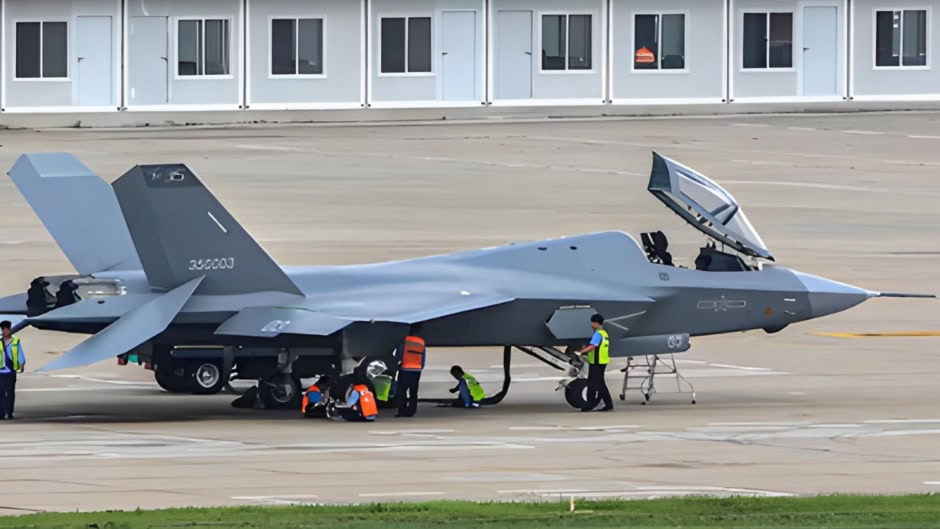
China has officially moved up the delivery timeline of its J-35 stealth fighters to Pakistan. Initially set for late 2026, the advanced aircraft will now arrive by mid-2026. Consequently, Pakistan is poised to become the very first foreign customer for China’s fifth-generation fighter jet. This accelerated timeline creates a significant strategic shift in South Asia’s military dynamics.
A Complete Strategic Package
This development represents much more than a simple aircraft purchase. China is providing a comprehensive military package. Specifically, the deal integrates the J-35 stealth fighters with KJ-500 airborne early warning systems and HQ-19 missile-defense platforms.
Together, these systems drastically enhance Pakistan’s operational reach, survivability, and combat effectiveness. Furthermore, pairing the stealth fighters with the KJ-500 allows Pakistani forces to operate with reduced radar emissions while maintaining precise targeting. This reflects a highly advanced, network-centric combat approach.
J-35 Stealth Fighters: Export Variant Features
Pakistan will receive the J-35A export variant. This twin-engine jet offers extended range and exceptional low-observable design features. For instance, the aircraft includes internal weapons bays, canted vertical stabilizers, and trapezoidal wings.
Currently, the exact delivery numbers and specific configurations remain unconfirmed. However, the early arrival has already triggered strategic recalculations across Islamabad, New Delhi, and Beijing.
Regional & Global Impact
This acquisition potentially gives Islamabad a clear qualitative edge over India’s current air fleet. Right now, India relies heavily on fourth-generation fighters like the Rafale and Su-30MKI. Additionally, India currently lacks operational fifth-generation stealth aircraft, because its Advanced Medium Combat Aircraft program remains years away. Therefore, the accelerated J-35 delivery could compel New Delhi to immediately reassess its procurement priorities, airbase deployment, and overall air defense systems.
Beyond South Asia, this deal highlights China’s growing aerospace capabilities. Ultimately, it marks China’s first major fifth-generation fighter export and strengthens its global defense export strategy by offering advanced combat platforms entirely free from the political restrictions typically imposed by Western suppliers.