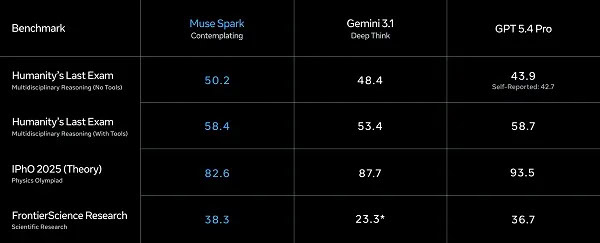
Meta’s Superintelligence Labs has released Muse Spark, the first large language model in its new Muse series. The company said the model represents a complete reimagining of its AI development stack, built from the ground up over the past nine months. Even in its early stages, Muse Spark has achieved industry-leading results across most critical AI benchmark tests, according to Meta.
The release is Meta’s first major output from the Superintelligence team, which is focused on advanced AI development. Meta described the Muse series as “a deliberate and scientific approach to model scaling where each generation validates and builds on the last before we go bigger.” The company said these models are “rooted in the relationships and context already at the center of your life,” signaling that the technology is designed to integrate deeply into Meta’s existing social platforms.

Muse Spark includes advanced multimodal capabilities, meaning it is able to process and understand visual cues alongside text. Meta said this allows the system to assess items as humans do, providing more context-based advice and more in-depth reasoning. The company expects this to improve the quality of responses and reduce the need for follow-up queries in conversations with Meta AI.
The model also includes a new shopping mode. Meta said Muse Spark is able to help users decide what to wear, how to style a room or what gifts to buy. The feature uses the model’s multimodal understanding to analyze images and provide recommendations based on visual context. This fits into Meta’s broader push to integrate commerce more deeply into its AI assistant and across its platforms.
Meta also highlighted health as a key use case, saying it is one of the top reasons people turn to AI. The company said it worked with a team of physicians to develop the model’s ability to provide helpful information on common health questions.
This is a sensitive area for AI companies, and Meta’s decision to lean into it suggests confidence in the model’s accuracy, though AI-generated health advice remains a topic of concern across the industry.
Meta has made a commitment of hundreds of billions of dollars in U.S. AI infrastructure spending, announced earlier this year. Muse Spark is now powering the Meta AI assistant in the Meta AI app, and the company plans to use it as a foundational model for future AI projects across its ecosystem. Meta has not announced pricing or API access details. It suggests Muse Spark is currently only for internal use across Meta’s products rather than as a standalone developer tool.
The model’s release positions Meta more directly against OpenAI, Google and Anthropic in the AI race. While Meta has been competitive through its open-source Llama model family, Muse Spark represents a shift toward a proprietary, vertically integrated approach built specifically for Meta’s consumer platforms.