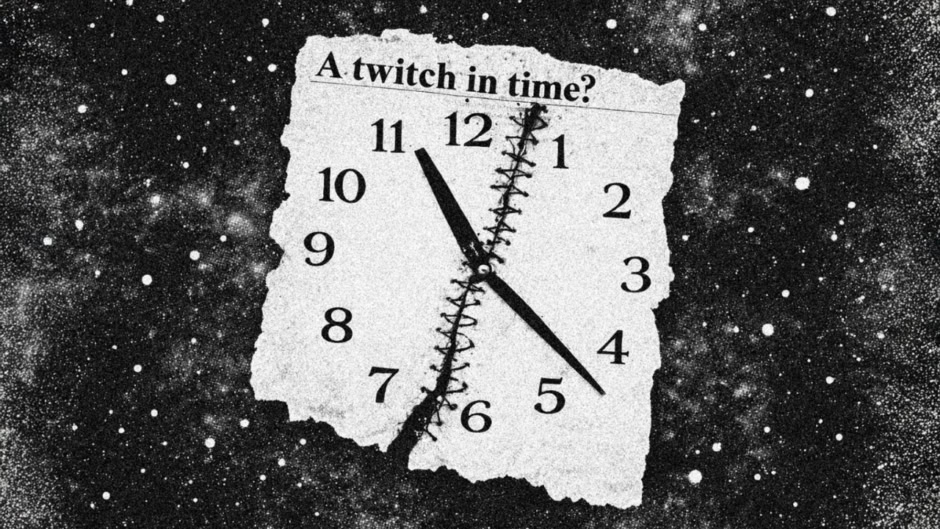
Physicists supported by the Foundational Questions Institute have discovered that quantum collapse models could introduce extremely small levels of inherent uncertainty into time itself, potentially setting a fundamental limit on how precise any clock could ever be according to research published in Physical Review Research.
The international group led by Nicola Bortolotti at the Enrico Fermi Museum and Research Centre in Rome examined alternative explanations known as quantum collapse models that suggest wavefunctions collapse spontaneously without requiring observation or measurement, unlike traditional interpretations of quantum mechanics.
In simple terms, imagine time as a perfectly smooth ruler that scientists use to measure everything in the universe. This new research suggests that at an incredibly tiny level far smaller than anything we can currently detect, that ruler might have microscopic imperfections built into it. This means there is a theoretical limit to how accurately we could ever measure time, even with perfect clocks. However, this flaw is so unimaginably small that it has absolutely no effect on anything in our daily lives, from the clocks on our phones to the most sophisticated scientific equipment used today.
The research team including Catalina Curceanu, Kristian Piscicchia, Lajos Diósi and Simone Manti examined two leading versions of these models including the Diósi-Penrose model which has long proposed a connection between gravity and the collapse of the wavefunction, and Continuous Spontaneous Localization where researchers established a quantitative relationship between this model and fluctuations in spacetime caused by gravity. The analysis shows that if these collapse models accurately describe reality, then time itself cannot be perfectly exact but would instead contain an extremely small level of inherent uncertainty that would set a fundamental limit on clock precision.
Quantum mechanics describes particles existing in multiple states simultaneously through superposition using mathematical objects called wavefunctions, however this clashes with daily observation where objects occupy one definite place or state at a time. Scientists usually propose that when a quantum system is measured or interacts with an observer its wavefunction collapses into a single outcome, with researchers in the 1980s beginning to develop theories where this collapse happens spontaneously without requiring observation.
The effect discovered by the team is far too small to impact any current technology with even the most advanced atomic clocks unable to detect it, as the uncertainty is many orders of magnitude below anything currently measurable meaning no practical consequences for everyday timekeeping. The findings offer a possible way to test these models against standard quantum theory while addressing one of physics’ biggest challenges of unifying quantum mechanics with gravity, as each theory works extremely well within its own domain but treats time in very different ways.
Standard quantum mechanics treats time as an external classical parameter that is not affected by the quantum system being studied, while general relativity describes time as something that can stretch and bend under the influence of mass and energy. By building on earlier ideas that quantum mechanics might be part of a deeper theory, the new research points to possible links between quantum behavior, gravity and the flow of time itself, with Curceanu emphasizing the importance of exploring unconventional ideas in physics.
The work was partially supported through FQxI’s Consciousness in the Physical World program and demonstrates that even radical ideas about quantum mechanics can be tested against precise physical measurements while reassuringly showing that timekeeping remains one of the most stable pillars of modern physics.