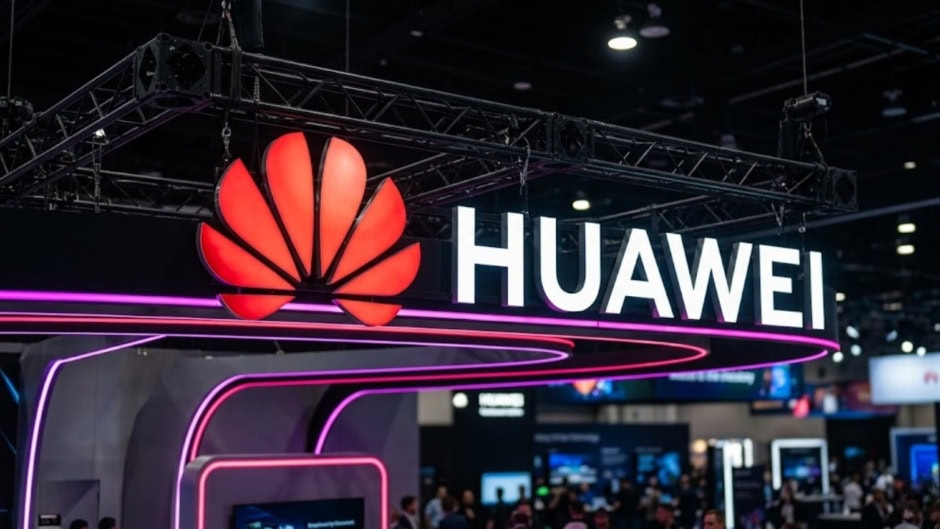
Huawei announced a new semiconductor design framework at a symposium in Shanghai on Monday, claiming it can reach transistor density equivalent to 1.4nm chip processes by 2031, all without access to advanced lithography equipment blocked by US sanctions.
The framework is called the Tau Scaling Law. Rather than shrinking transistors further, it focuses on reducing the distance data travels inside chips, lowering latency, and improving signal movement across computing systems. Huawei says the approach can deliver leading-edge performance through system-level efficiency rather than through smaller transistors alone.
What Is LogicFolding and Why It Matters
The first application of Tau Scaling is a chip architecture called LogicFolding. Huawei says it shortens internal wiring distances significantly, boosting performance without requiring newer fabrication nodes. Kirin smartphone chips based on LogicFolding will launch later this year. Huawei also plans to bring the architecture to its Ascend AI processors and large-scale AI computing clusters by 2030.
Omdia semiconductor research director He Hui described the approach as a credible path forward. He said Huawei is shifting from node-driven scaling to system-level efficiency scaling, which is a viable way to extract more performance when leading-edge lithography is out of reach.
Huawei said its chip division has designed and mass-produced 381 chips over the past six years using concepts related to Tau Scaling, spanning smartphones, AI computing, and industrial applications.
The Sanctions Context
US export controls have blocked Chinese firms from accessing extreme ultraviolet lithography tools, which manufacturers like TSMC and Samsung use to produce the world’s most advanced chips. Because Huawei cannot use those tools, it is building a parallel path that sidesteps the fabrication bottleneck entirely.
Huawei did not release independent performance data to support its claims. Analysts say significant challenges remain. Counterpoint Research associate director Brady Wang flagged cost, power consumption, heat management, and system integration as major hurdles, particularly for cloud AI servers.
Huawei chip head He Tingbo acknowledged the obstacles but expressed confidence in the company’s long-term trajectory. He said the company has found strong solutions within its constraints, and predicted its mobile and AI computing products will be competitive over the next decade.