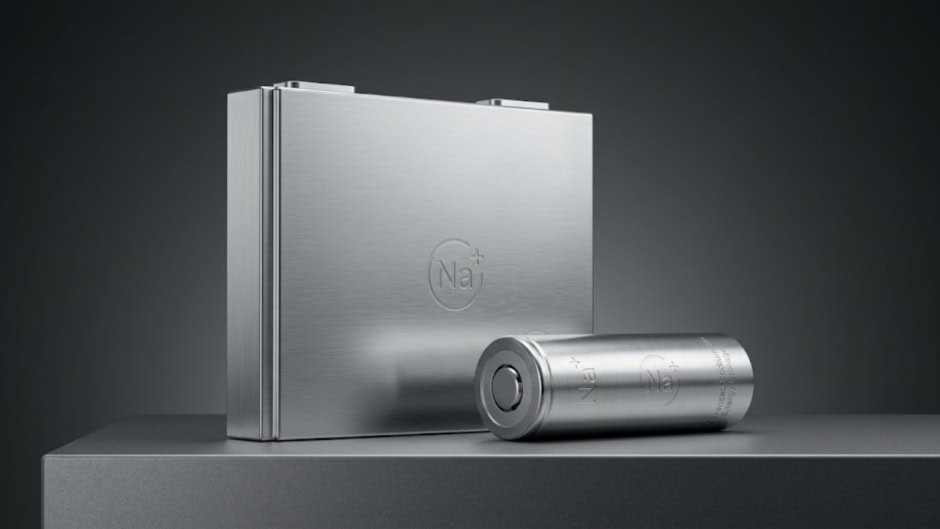
Researchers in China have developed a new electrolyte that lets sodium metal batteries charge in roughly four minutes, run for 6,000 hours without failure, and operate more safely.
A team from Southeast University built the material alongside HiNa Battery Technology and Yangzhou University. They designed a dual-mediator, quasi-solid-state electrolyte that solves two stubborn problems in sodium metal batteries. The first is slow sodium-ion movement. The second is unstable interfaces that cause dendrites, the needle-like structures that trigger short circuits and kill batteries.
Sodium has drawn growing interest as a cheaper alternative to lithium. It is abundant, widely available, and far less exposed to supply chain risks. Until now, though, achieving fast charging without wrecking battery lifespan has been difficult.
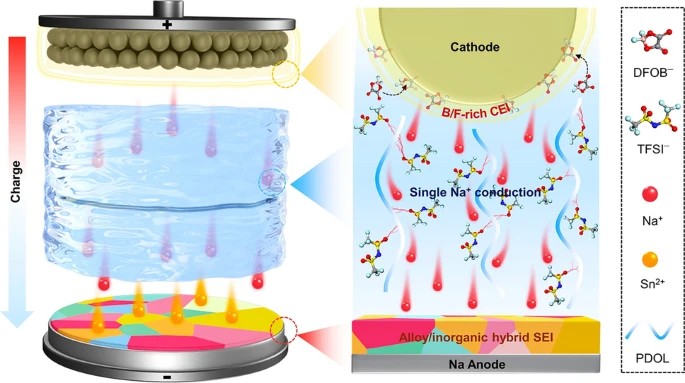
The new electrolyte changes that. It records a sodium-ion transference number of 0.94, far above the 0.4 to 0.7 range of conventional designs. Higher numbers mean better charging performance. The material pairs tin ions with difluoro(oxalato)borate ions, known as DFOB. Together, they reshape the electrolyte and free more sodium ions to move quickly. Simulations showed sodium ions diffusing about six times faster than in conventional liquid electrolytes.
The design also builds protective layers on both electrodes during use. At the sodium metal anode, tin ions create an alloy-rich surface that spreads sodium evenly. At the cathode, DFOB forms a thin but tough protective film that slows degradation. These layers suppress dendrites and keep the battery stable under heavy current.
The performance numbers rank among the strongest reported for sodium metal systems. In testing, sodium symmetric cells ran for 6,000 hours without dendrite failure. When paired with sodium vanadium phosphate cathodes, the batteries still delivered strong output at a charging rate equal to a full charge in about four minutes. They also kept 90% of their capacity after 2,000 charge-discharge cycles at a demanding 3C rate. The electrolyte stayed stable up to 4.7 volts, opening the door to higher-voltage cathodes.
The team went beyond lab coin cells too. Pressure-free pouch cells kept working even while being repeatedly folded, and they successfully powered a smartphone. The researchers say the approach could extend to lithium and potassium batteries, while staying compatible with existing manufacturing methods. The study appeared in the journal Nano-Micro Letters.
If this technology reaches commercial production, it could lower the price of reliable backup power for households and businesses across the globe. The breakthrough could push sodium closer to challenging lithium-ion as the dominant battery technology.