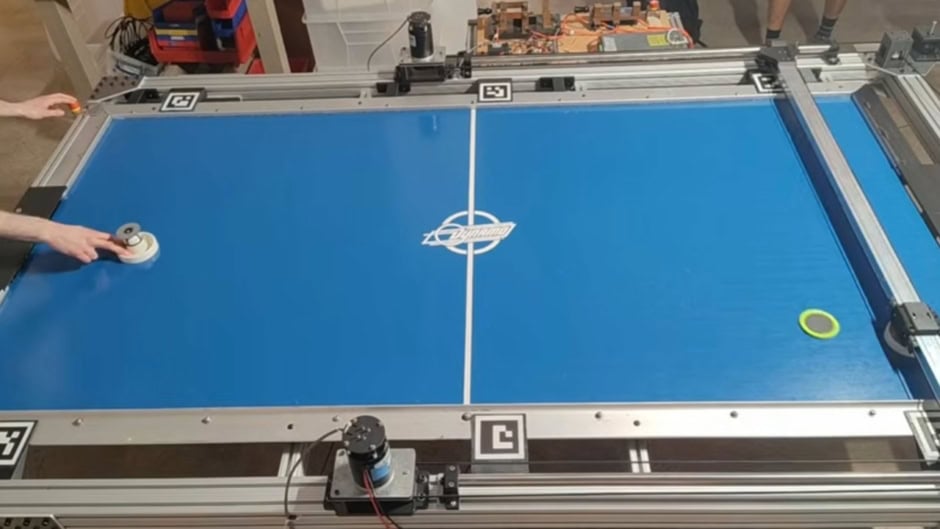
A trio of students at the University of British Columbia has built an AI-powered air hockey robot. What is cool about the robot is that it learned to play the game entirely inside a virtual simulation, without ever touching a real table until it was ready to face human opponents.
Traditional AI robots learn through thousands of real-world trial-and-error runs, which is slow, expensive, and hard on hardware. The UBC team took a different approach. They built a highly accurate digital twin of an air hockey table and trained their AI there first, letting it make all its mistakes in simulation before deploying on physical hardware.
Air hockey is notoriously difficult to simulate accurately. The puck moves fast, rebounds unpredictably, and is affected by subtle imperfections in paddle contact and wall angles. Any robot also has to compensate for motor lag, camera latency, voltage dips, and mechanical vibration in real time. Tiny errors compound into game-losing mistakes.
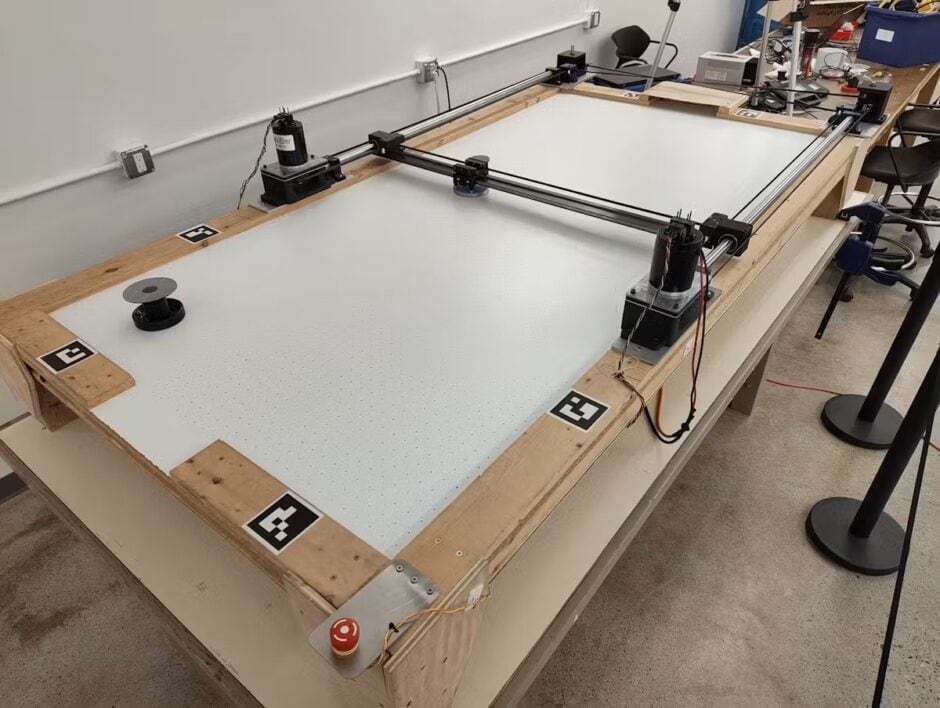
To solve this, the team deliberately introduced imperfections into the training environment. A technique called domain randomization added variables like uneven rails, warped surfaces, inconsistent rebounds, and power fluctuations. This trained the AI to predict a range of probable puck positions rather than one exact outcome, closely mimicking how a human player reads the game.
The team also replaced conventional physics engines like Unity and Unreal with a soft actor-critic training framework, a reward-and-punishment learning model. Over millions of simulated games, the AI refined its decision-making continuously. On the hardware side, a 120 frames-per-second overhead camera and retroreflective tape on the puck gave the robot sharp real-time tracking.
When transferred to the real table, the AI challenged human players immediately with no additional tuning. The team says the same sim-to-real approach could accelerate training for drones, autonomous vehicles, and industrial robots.