China has a new answer to NVIDIA, and it comes from a chip startup few had heard of a month ago. Shanghai-based Dongfang Suanxin unveiled its flagship DF1000 processor at a Monday launch event. The company says the chip can rival NVIDIA while sidestepping the advanced manufacturing that US export controls have placed off-limits. So instead of chasing the smallest transistors, it is changing where the performance battle happens.
“We did not blindly pursue the most advanced processes. Instead, we relied on existing, large-scale memory resources available internationally—even under capital constraints—and used architectural innovation to compensate for process disadvantages,” founder Wei Shaojun told media.
Rather than racing for cutting-edge lithography, the DF1000 leans on software-defined computing and 3D-stacked near-memory design. That approach tackles the real AI bottlenecks, namely memory bandwidth and data movement, without needing the latest fabrication nodes.
“We have to forge a path of our own,” Wei Shaojun said during the launch. “That path cannot be about passively catching up within a framework set by others. We need independent architecture, original technology, a self-sustaining ecosystem and a secure, controllable supply chain.”

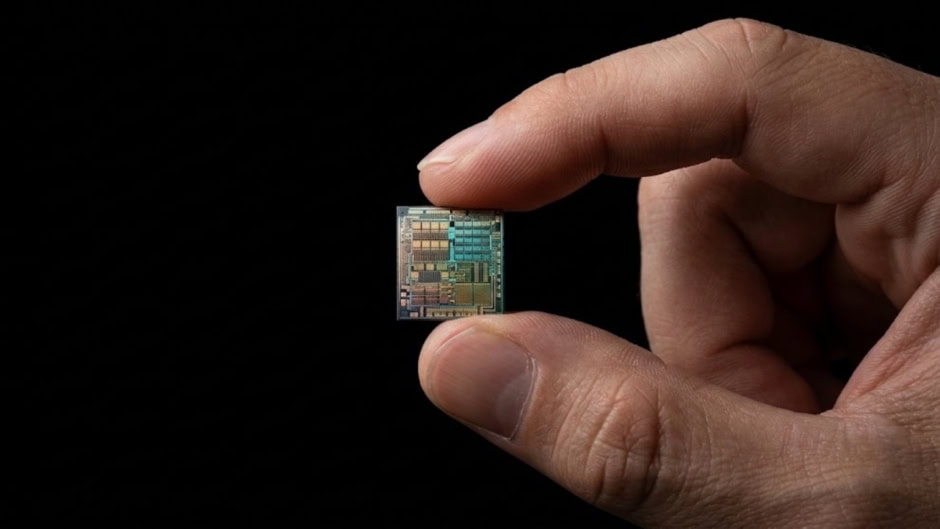
The specs, if they hold, are striking for a mature process. Built on a 14-nanometer process, the chip is claimed to deliver 520 teraflops of BF16 performance, along with 6.4 TB/s of memory bandwidth and 900 GB/s of inter-chip communication bandwidth. The company says it is ready for mass production, with shipments starting before year-end. It also teased the DF2000 for late 2026 and the DF3000 for 2027.
Dongfang Suanxin was established on May 20, 2024, and is based in the vibrant Zhangjiang district of Shanghai. The company has grown to a team of over 500 talented individuals and boasts a valuation of around 12.3 billion yuan (roughly $1.8 billion). The roots of its technological prototype can be traced back to 2006. Wei Shaojun reminisced about that time when China’s integrated circuit industry was starting to pivot towards mass production. The team recognized that as manufacturing processes advanced beyond the 14nm threshold, the challenges of high costs for multi-variety, small-batch ASICs would become significant. This insight led them to embark on research into reconfigurable computing chips, which eventually evolved into what we now know as software-defined chips. Dongfang Suanxin wants the DF3000 to surpass NVIDIA’s H200 and B300 processors, which is a bold target for a firm founded barely two years ago. It already employs over 500 people and draws backing from state funds plus venture arms tied to Xiaomi and JD.com. So this is no garage operation.
Still, real caution is warranted, since a demo is not a product. Analysts note that beating NVIDIA means matching its CUDA software, developer tools, and manufacturing yield, where many chip startups have died. For Pakistan and other markets priced out of top NVIDIA hardware, though, a credible third option could eventually reshape what AI compute costs.