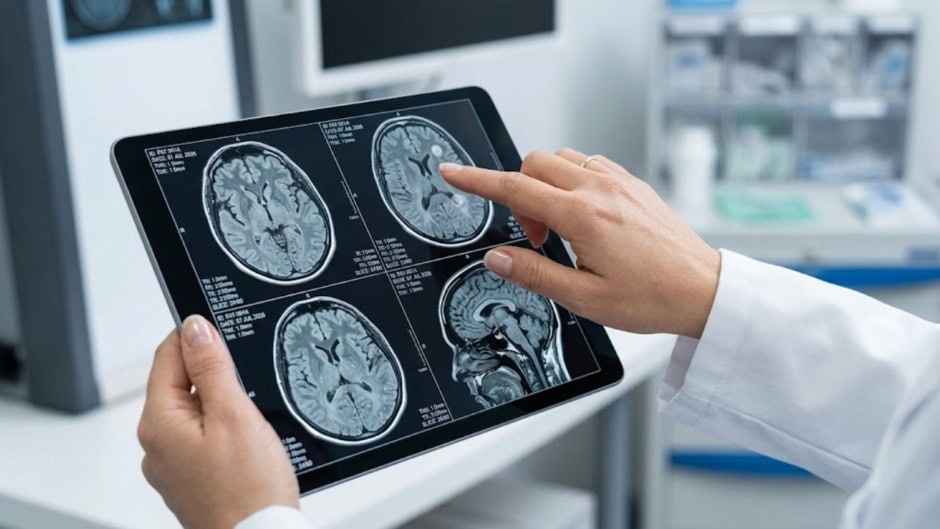
Chinese researchers have achieved a significant breakthrough in neuromorphic computing, developing a brain chip that reconstructs complex brain structures in real time at unprecedented speeds. Researchers from Peking University and the Chinese Academy of Sciences published their findings in the prestigious journal Science on July 3, 2026, revealing a chip capable of performing brain mapping tasks 50 to 478 times faster than NVIDIA’s A100 graphics processing unit.
The chip was developed by a team led by Professor Yang Yuchao from Peking University’s School of Integrated Circuits and researcher Song Zhitang from the Shanghai Institute of Microsystem and Information Technology under the Chinese Academy of Sciences. The device is fabricated using a 40-nanometer process and integrates phase-change memristors with artificial neural networks to create a specialized neuromorphic system.
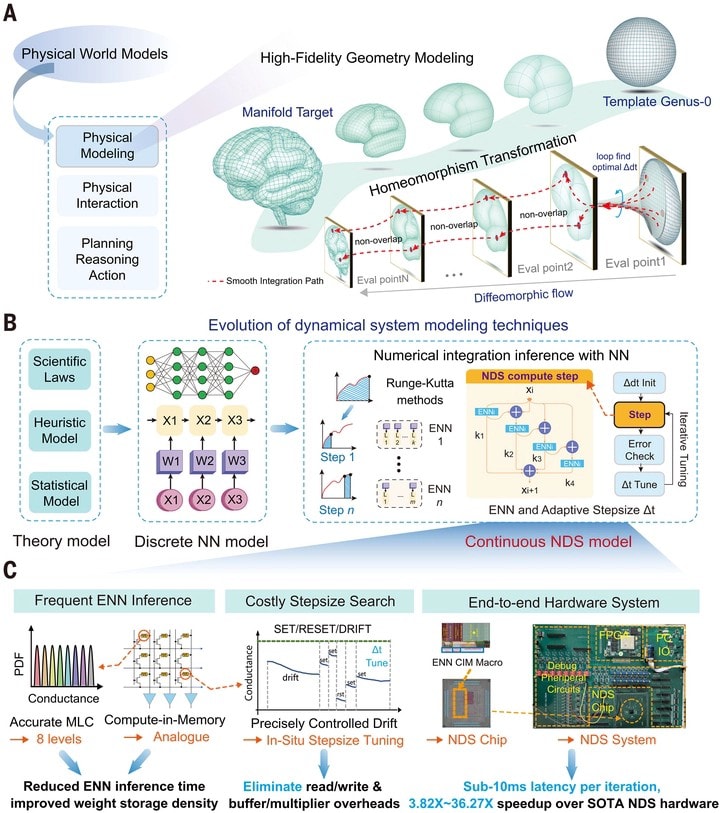
The breakthrough addresses fundamental limitations in traditional computing architectures where memory and processing units are physically separated. This separation creates constant data movement between storage and computation components, causing delays and energy inefficiency. The new chip adopts an “in-memory computing” architecture where data storage and computational processes occur within the same memory array. This integration dramatically reduces latency while lowering power consumption.
The device achieves ultra-low latency computation of 2.12 milliseconds, enabling real-time reconstruction of the human brain’s intricate folded surface in approximately half a second. The human brain contains complex folds that increase its surface area, allowing billions of neurons to fit inside the skull. Reconstructing these structures has traditionally required powerful computing systems and lengthy calculations, limiting their use in time-sensitive medical environments.
Yang emphasized the clinical significance of the development. He stated the chip could revolutionize brain-computer interfaces and enable new approaches to diagnosing and treating brain diseases. The technology provides a hardware foundation for real-time intraoperative neuronavigation during brain surgery and early screening for Alzheimer’s disease. Yang also noted that personalized and dynamic digital brain twins will become possible, where patients receive customized three-dimensional brain models for precise treatment planning.
Researchers from Germany’s Juelich Research Centre provided commentary comparing the approach to processing raw milk on a dairy farm instead of transporting it to a factory, highlighting the efficiency gains from performing computation where data resides.
The development arrives as China invests heavily in brain science research through its China Brain Project, which prioritizes understanding brain function and developing brain-inspired artificial intelligence. The global brain-computer interface market is projected to reach 145 billion dollars by 2040, positioning this technology as potentially significant for medical and consumer applications.
You can read the research here.