Surgeons at London’s National Hospital for Neurology and Neurosurgery achieved a medical first on August 27, 2026, using real-time machine intelligence to support a live brain operation. Since the system helped doctors remove a pituitary tumor while protecting the patient’s eyesight, this marks a significant milestone for computer vision technology entering actual operating rooms.
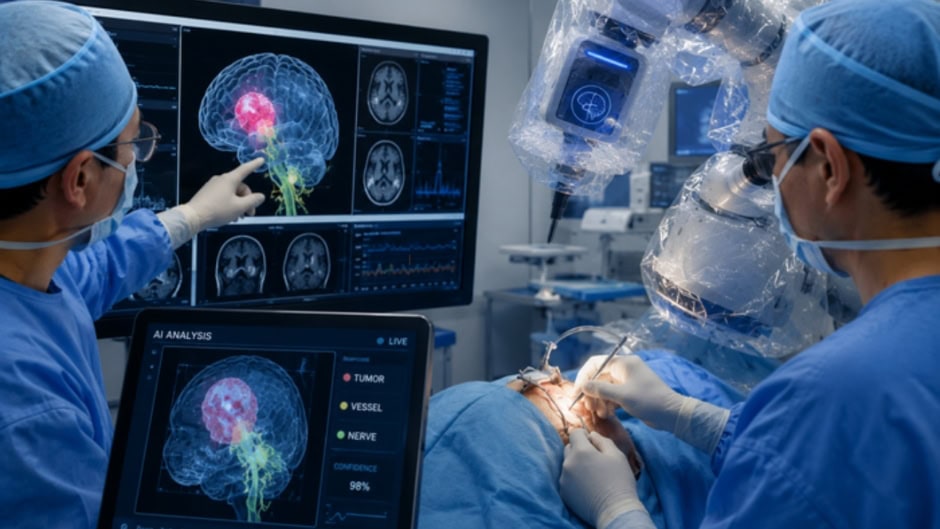
The procedure took place as part of a clinical trial, with surgeons using software developed at University College London to analyze the operation’s live video feed. Because the system identified critical anatomy as surgeons worked, the team gained an additional visual reference within one of neurosurgery’s most confined operating environments.
For 48-year-old patient Rhys Hibbert, the technology supported surgery addressing a brain tumor that had progressively damaged his vision. Doctors successfully removed the growth without harming his eyesight, demonstrating the system’s practical value during genuinely high-stakes surgical conditions.
Pituitary surgery presents unusual challenges for computer vision systems, since surgeons work around structures separated by only tiny distances, including optic nerves and major blood vessels. Because a small error near the surgical site can cause blindness, stroke, or death, precision remains absolutely critical throughout the procedure. UCL’s system processed live endoscopic video rather than relying solely on pre-surgery scans, highlighting potentially risky structures as the operation unfolded in real time.
Hani Marcus, consultant neurosurgeon at the hospital and UCL professor, performed the procedure alongside surgical resident Danyal Khan while retaining full control throughout.
Researchers developed the system at UCL’s Hawkes Institute, training it using hundreds of annotated videos from previous endoscopic pituitary operations.
Sophia Bano, the project’s technical lead, explained that the system recognizes critical anatomy, surgical instruments, and interactions between instruments and tissue.
The technology runs on NVIDIA’s Clara IGX platform, which targets real-time machine intelligence applications in medical devices. Researchers ultimately envision future versions tracking surgical instruments and monitoring tissue interactions, potentially providing surgeons with additional feedback during complex procedures.
Hibbert’s tumor measured approximately 11 millimeters and had caused severe hormone problems along with worsening vision before doctors discovered it following his collapse in December 2024. His vision improved dramatically after surgery, and within a week, he could walk independently without glasses or walking sticks that had previously become necessary.
The trial received funding from the UK’s National Institute for Health and Care Research and Google.