University of Nebraska researchers confirmed that hafnium oxide naturally exhibits antiferroelectric properties. The discovery resolves a long-standing question about the material’s electrical behavior. Hafnium oxide can now be categorized as a true antiferroelectric material suited for next-generation electronics.
To those unfamiliar, antiferroelectric materials are fascinating to science because they have electric dipoles that naturally align in opposite directions. This opposing polarization tends to cancel each other out under typical conditions, creating a unique balance. However, an applied voltage forces those dipoles into alignment. Removing the voltage allows the material to return toward its original state. That behavior gives engineers precise control over how materials store and release electrical energy.
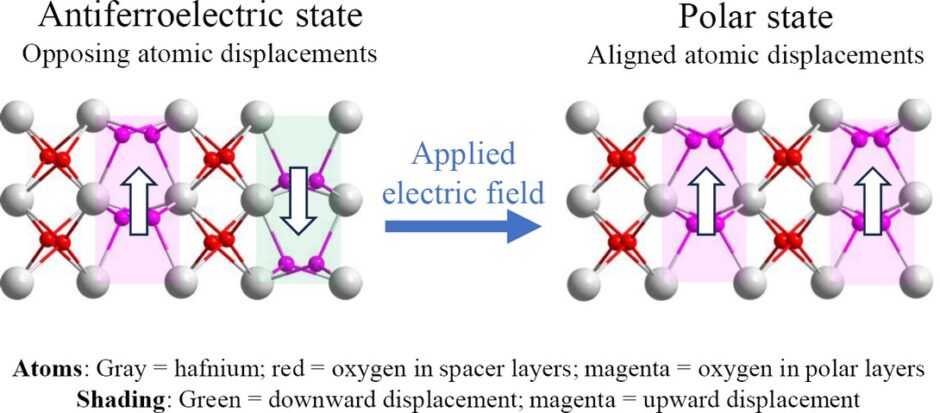
The research team used multiple measurement techniques to establish the material’s identity. Xiaoshan Xu produced extremely thin hafnium oxide films using pulsed laser deposition. Meanwhile, Alexei Gruverman employed scanning probe microscopy to examine the film’s electrical response. His measurements revealed that the material could shift between antipolar and polar states.
Critically, the material displayed the distinctive double hysteresis loop associated with antiferroelectric behavior. Researchers observed antiparallel electric dipoles within the material itself. Furthermore, interphase boundaries provided additional evidence confirming the electrical structure. Evgeny Tsymbal supplied theoretical support through computer-based modeling. His calculations matched the experimental observations precisely. Researchers at Washington University in St. Louis examined the material at atomic resolution, confirming the quality of the crystal structure.
“The paper is very exciting,” said lead author Xu, Susan J. Rosowski Professor of physics and astronomy. “Not only have we discovered this new material with inherent antiferroelectricity, but the material is already compatible with the modern electronics we already have, including our cellphones and computers. That sets it apart from all the other materials that have ferroelectricity.”
The heat stability marks a significant advantage over conventional antiferroelectric materials. Hafnium oxide remains stable at temperatures reaching 1,562 degrees Fahrenheit. Additionally, the researchers found that hafnium oxide becomes more stable as its thickness decreases. Their experiments maintained the antiferroelectric structure down to 0.6 nanometers. Many antiferroelectric materials contain lead, creating environmental and manufacturing concerns. Hafnium oxide carries no such limitation.
The discovery could enable high-performance capacitors with reduced physical size. Engineers could develop more compact electronic systems using this material. Solid-state cooling represents another promising direction. Furthermore, memory technology could benefit from efficient electrical energy storage. The research involved materials fabrication, microscopy, electrical testing, and theoretical modeling.