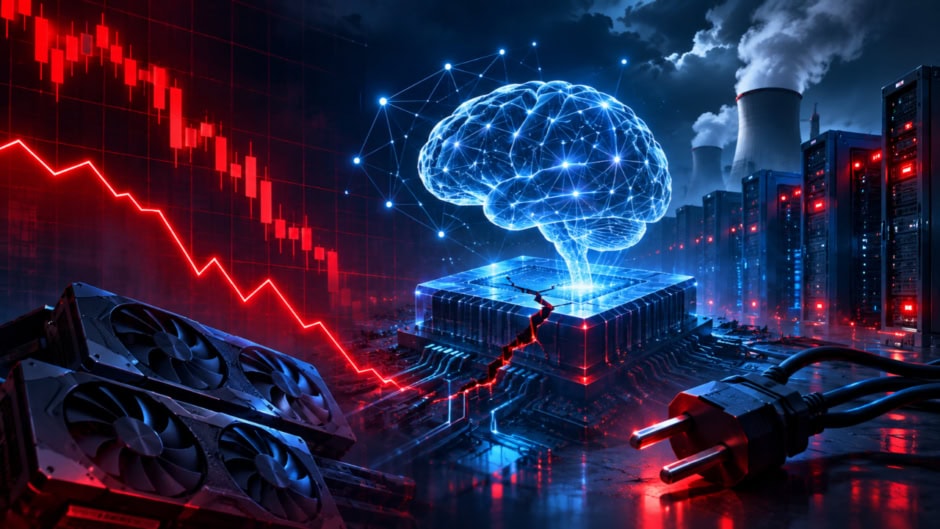
The AI industry has a problem that no model can solve. It needs enormous amounts of electricity, water, and land to operate. However, the communities supplying those resources increasingly refuse to give them up. What started as scattered local opposition has become a coordinated global revolt against data center construction.
This is the infrastructure crisis hiding behind the AI boom.
AI infrastructure spending is projected to approach $1 trillion annually. Yet that projection assumes companies can actually build where they need to. Across the United States, Europe, and parts of Asia, that assumption is now collapsing. In the US, voters rejected data center development in 40 out of 41 midterm ballot measures. Incoming governors in key states have promised moratoriums on new construction. As a result, Goldman Sachs estimates that 45% of planned US data center capacity faces risk. Wall Street responded by erasing roughly $2.5 trillion in tech stock value within a single day.
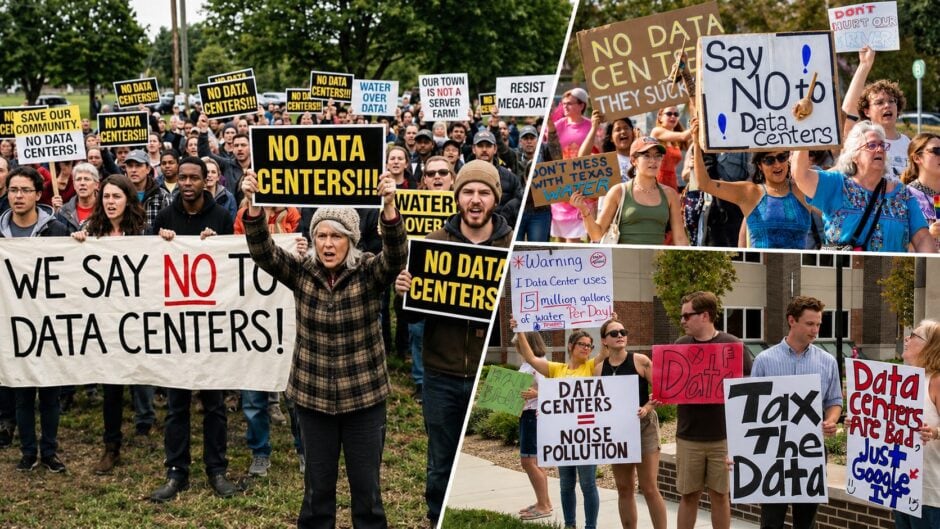
The backlash extends far beyond America, though. In Amsterdam, protesters broke into a Microsoft construction site. Ireland has restricted new power grid connections for large energy users. Meanwhile, across Southeast Asia, governments are weighing whether attracting tech investment is worth straining domestic energy supplies.
The grievances are consistent everywhere. Data centers consume electricity like small cities. They drive up local power bills. They use vast quantities of water for cooling. And despite costing billions, they create remarkably few permanent jobs.
The industry’s response reveals the severity. Meta confirmed it now considers building new facilities outside the US. OpenAI’s CEO floated building in the desert. By that same week, OpenAI rebranded data centers as “AI compute campuses.” The industry also spent roughly $200 million on political campaigns. Despite that spending, anti-data center candidates won almost everywhere.
For the AI bubble question, this matters enormously. AI models cannot run without compute. Compute cannot exist without data centers. And data centers cannot exist without public consent that is no longer guaranteed. The bubble may not pop. Instead, it likely deflates into something slower and more negotiated.
The AI industry built the most powerful technology in a generation. It forgot to ask whether the world had room for it.