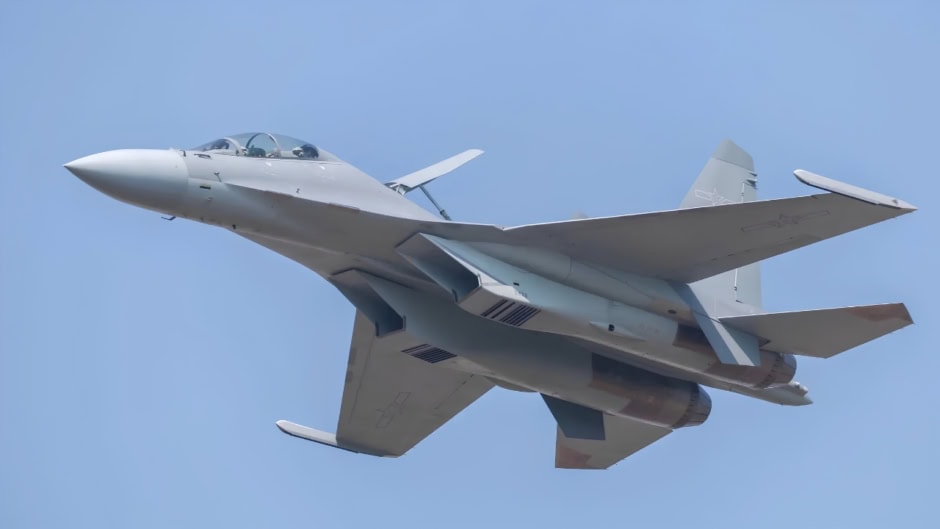
Chinese J-16 fighters travelled about 3,700 miles to reach Egypt, a journey that took roughly nine hours and included mid-air refueling. The aircraft arrived at an Egyptian airbase on Friday morning, marking a significant milestone for China’s military reach across Asia and Africa.
The aircraft are assigned to Eagles of Civilization 2026, the second China-Egypt bilateral air exercise, scheduled from mid-August until early September and focused on air superiority, combat tactics, force employment, and personnel recovery. The deployment represents an escalation from the previous year’s exercise.
It added that the service personnel involved in the exercise had started preparations for the joint exercise. The PLA has previously said the drills would finish early next month. The preparation phase has begun ahead of the full exercise operations.
The J-16 is a twin-seat, twin-engine multirole fighter that forms an important part of China’s modern combat aircraft fleet. The aircraft is regularly used for missions along the country’s eastern coast and around strategic areas including the South China Sea and Taiwan Strait. The fighter represents one of the PLA Air Force’s most capable aircraft outside the stealth-equipped J-20.

The deployment constitutes a significant upgrade from previous exercises. During its inaugural joint exercise with the North African country last year, China deployed J-10C fighters, which are lighter, single-engine multi-role jets. The shift to heavier J-16 aircraft demonstrates increased confidence in longer-range power projection.
Unlike the lighter J-10C formation deployed during the inaugural 2025 exercise, the heavier J-16 package demonstrates greater combat radius, payload capacity, sensor integration, and endurance across a geographically demanding deployment corridor linking China with Egypt. This capability upgrade allows Egypt to evaluate more sophisticated aircraft for regional operations.
The formation composition reveals integrated operations planning. The core formation photographed in Pakistan comprised at least six J-16 fighters, one KJ-500 airborne early-warning and control aircraft, and one Y-20 strategic transport. The inclusion of specialized support aircraft demonstrates systematic force structure organization.
The deployment is part of the Eagles of Civilisation 2026 exercise, the second joint air training event between China and Egypt. The exercise brings together multiple Chinese aircraft types, including fighters, aerial refueling aircraft, special-mission platforms and helicopters. The integrated force composition enables comprehensive training scenarios.
A member of the PLA Air Force said that during the deployment, the aerial refueling aircraft not only carried out mid-air refueling missions but also served as an airborne command node. Multi-role functions enhance operational efficiency across long-distance deployments.
China has strategic motivations for the deployment beyond military training. Song Zhongping, a Chinese military commentator and former PLA instructor, said the deployment reflected Beijing’s effort to train its air force in unfamiliar locations and under unfamiliar conditions. Operating in distant theaters develops capabilities that cannot be replicated domestically.
The broader geopolitical context involves multiple simultaneous operations. Following the completion of China-Thailand Falcon Strike 2026 joint air force training on Thursday, the PLA Air Force is set to kick off the “Falcon Shield 2026” joint training with the United Arab Emirates (UAE) in Hotan, Northwest China’s Xinjiang Uygur Autonomous Region. Multiple bilateral exercises demonstrate China’s expanding international military engagement.
The J-16, a twin-seat multi-role fighter nicknamed the Hidden Dragon, regularly patrols along China’s east coast and potential flashpoints such as the South China Sea and Taiwan Strait. The jet has previously featured in other overseas drills, including with Russia and Pakistan, but this is the first time it is taking part in an exercise with the Egyptian air force. The African deployment marks a geographic expansion beyond previous operational patterns.