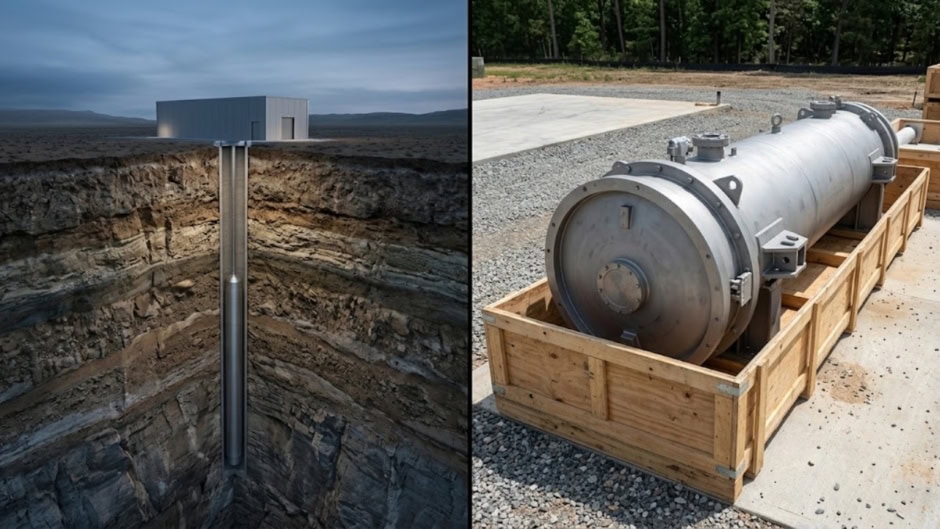
Deep Fission delivered its prototype reactor canister to a Kansas test site Wednesday. The milestone advances the company’s plan to place nuclear reactors one mile underground. The factory-built canister completed fabrication, hydrostatic testing, and delivery to Parsons, Kansas.
The California startup designs small modular reactors for deep borehole deployment. Its Gravity Nuclear Reactor uses a standard pressurized water reactor and low-enriched uranium fuel. The design places the reactor roughly 6,000 feet below the surface. Surrounding rock and water provide natural containment, replacing thick concrete-and-steel domes.
The concept could reshape nuclear economics. Traditional reactors require massive surface foundations and heavy pressure vessels. Deep Fission argues geology handles much of that work. At one mile deep, water column pressure reaches 160 atmospheres, matching conventional reactor conditions. This natural pressure reduces the need for expensive steel hardware.
The prototype supports the company’s Proof-of-Concept Well program. The nearly full-scale demonstration tests installation methods and infrastructure readiness. It uses commercial-grade, non-nuclear components before any fuel loading. The program validates each stage of underground deployment under real-world conditions.
Each Gravity reactor generates 15 megawatts thermal, roughly 5 megawatts of electricity. The small footprint means dense power output on minimal land. Ten reactors on one site would deliver 150 megawatts electric. The design targets data centers and industrial sites needing constant power.
Deep Fission participates in the Department of Energy’s Reactor Pilot Program. The initiative targets initial criticality for at least three test reactors by July 4, 2026. CEO Liz Muller acknowledged the timeline remains extremely challenging. The company broke ground in December at the Great Plains Industrial Park.
The startup secured customer interest for 12.5 gigawatts through non-binding letters of intent. Data center developers and industrial parks signed agreements. Full-scale commercial projects could begin construction in 2027 or 2028. Regulatory approvals from the DOE and NRC will determine the pace.