“Digital Pakistan” needs more than just smartphones. A new analysis by Gallup Pakistan Digital Analytics reveals a sobering truth today, on July 9, 2026. Only 8.7% of Pakistani households own a desktop or laptop. Therefore, the ongoing debate about digital transformation assumes a level of access that simply does not exist.
A smartphone can easily connect people to the internet. Still, it cannot build a comprehensive knowledge economy.
“Digital Pakistan” Falling Behind Global & Regional Peers
Pakistan currently ranks at the absolute bottom among selected nations for computer ownership. We sit roughly on par with India (9%) and Bangladesh (9%). Meanwhile, other countries embed digital participation deeply into their daily lives.
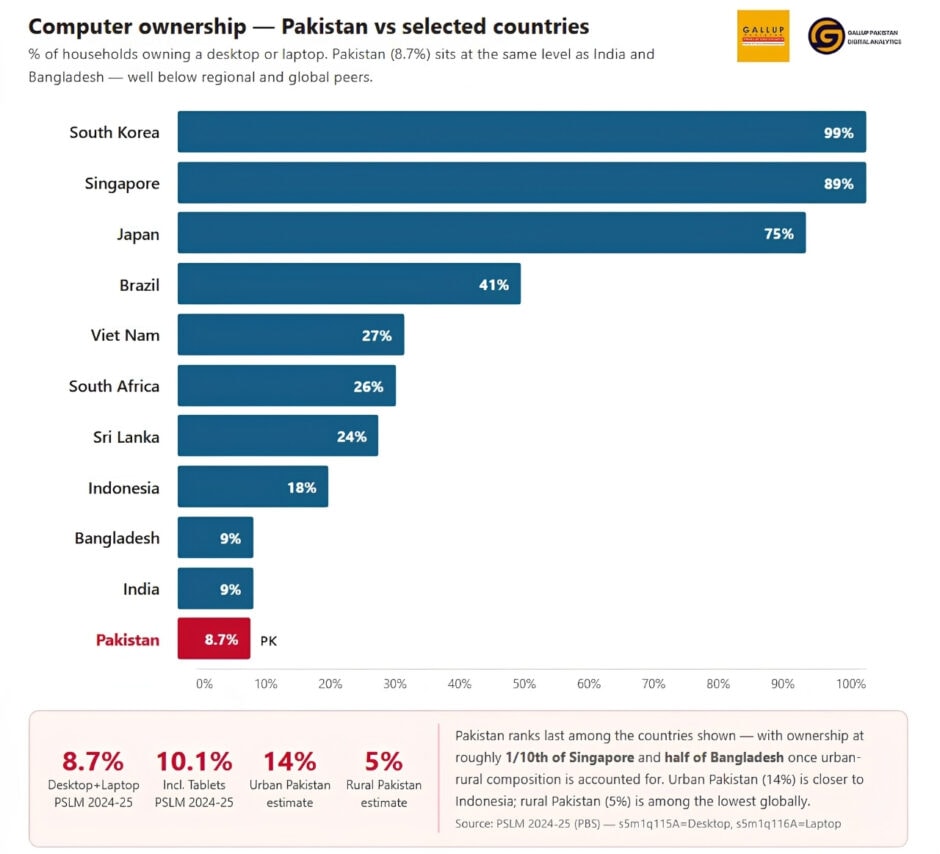
Consider the stark contrast. South Korea leads the pack with a massive 99% ownership rate. Singapore follows closely at 89%. Furthermore, Japan sits strongly at 75%. Even developing nations perform significantly better. Brazil boasts 41% ownership. Vietnam reaches 27%, South Africa hits 26%, and Sri Lanka secures 24%. Finally, Indonesia doubles our rate at 18%.
The Stark Urban-Rural Divide
National averages only tell half the story. The urban-rural divide highlights an equally important issue. In urban Pakistan, computer ownership sits at 14%. This figure closely mirrors Indonesia’s national average. Conversely, rural Pakistan drops to a dismal 5%. This rural estimate ranks among the absolute lowest globally.
What happens if we include tablets in the mix? The overall national number barely moves. It only rises to 10.1%. Consequently, when we account for this urban-rural composition, a harsh reality emerges. Pakistan’s ownership equals roughly half of Bangladesh’s and a mere one-tenth of Singapore’s. Official indicators from the PSLM 2024-25 (PBS) report confirm these grim statistics.
Productive Access Over Basic Connectivity
The core issue extends far beyond simple internet access. Instead, we must focus intensely on productive digital access. A laptop or desktop directly determines who can participate meaningfully in the modern economy.
These devices empower users. They allow people to code, design, write, and analyze data. Moreover, they enable workers to freelance and learn advanced skills. Nearly nine out of ten Pakistani households lack this basic device infrastructure. As a result, the country cannot successfully build a functioning knowledge economy.
Digital policy must evolve immediately. Policymakers must move entirely beyond empty slogans. Ultimately, the real question remains simple:
Who actually has the tools to participate?