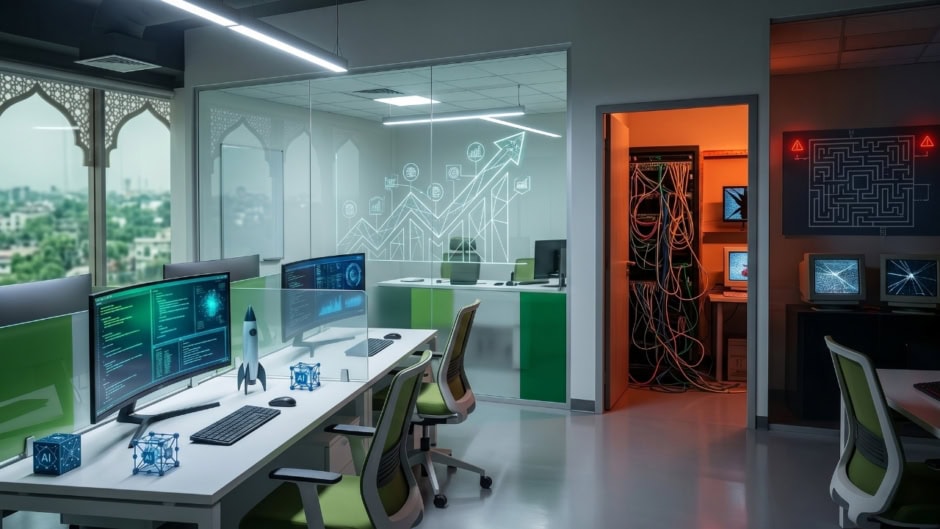
The Higher Education Commission (HEC) recently released the results of the National Skills Competency Test (NSCT) 2026. While the baseline metrics outline the rankings of various institutions, a deeper dive into the raw data reveals a much more critical story. The numbers show exactly where Pakistan’s future tech workforce is exceptionally strong, and where the academic foundation is crumbling.
The Strengths: Web Development & the Hype Cycle
Pakistan’s upcoming IT graduates show clear strength in surface-level development and trending technologies. According to the results shared by HEC, the highest proficiency area is Web Development Basics at 54.1%.
Furthermore, students are performing relatively well in buzzword domains. AI & Machine Learning scored a 50.8% proficiency rate, while Software Engineering stood at 50.1%. These numbers indicate that students are actively gravitating toward front-end development and high-demand marketing terms. They are learning the tools that allow them to jump straight into the freelance market.
The Weaknesses: A Catastrophic Failure in Engineering Fundamentals
Conversely, the data exposes a terrifying reality. Pakistan’s IT graduates are failing miserably at the fundamental building blocks of computer science. While students can build basic websites, they cannot conceptually manage the systems running them.
The proficiency metrics for core computing architecture are remarkably weak:
- Operating Systems: 33.8% (The absolute lowest score)
- Computer Networks & Cloud Computing: 39.6%
- Data Structures & Algorithms: 40.2%
- Database Systems: 42.3%
These technical areas represent the backbone of high-tier software engineering. Without mastering data structures and networking, graduates cannot build scalable architecture or secure enterprise systems. Consequently, international tech firms looking for deep engineering talent will look elsewhere if Pakistani graduates only hold surface-level coding skills.
HEC NSCT 2026 Results Exposed The Regional Divide
The skill gap is not just academic; it is heavily geographic. The Islamabad Capital Territory (ICT) leads the nation with a 52.9% pass rate. However, provincial performance plummets drastically outside the capital region.
| Province/Region | Pass Rate |
| Islamabad Capital Territory (ICT) | 52.9% |
| Sindh | 42.0% |
| Punjab | 39.4% |
| Gilgit-Baltistan | 32.6% |
| Azad Jammu & Kashmir | 31.0% |
| Khyber Pakhtunkhwa | 30.2% |
| Balochistan | 29.0% |
This massive regional disparity indicates that tech education and resources remain heavily centralized. As a result, the remote regions are being left behind with sub-par training facilities.
What We Learnt From The HEC NSCT Results
Ultimately, the NSCT 2026 benchmark is a wake-up call for local universities. You can read the full breakdown of the highest-scoring individual students and top university averages in our previous coverage of the official HEC NSCT 2026 results announcement.
Pakistan does not have a shortage of IT degrees… It has a severe shortage of deep technical competence. If the country wants to transition from a low-cost outsourcing hub to a global tech powerhouse, universities must stop treating computer science like a data-entry diploma. They must force students to master core engineering principles rather than just chasing trending tech buzzwords.