The Higher Education Commission has released its Annual ORIC Self-Assessment Evaluation Report for financial year 2024-25, ranking the Offices of Research, Innovation and Commercialization (ORICs) of 95 universities across Pakistan into four performance tiers.
Only 7 institutions achieved the highest W category out of 95 evaluated, while an equal 7 were declared underperforming.
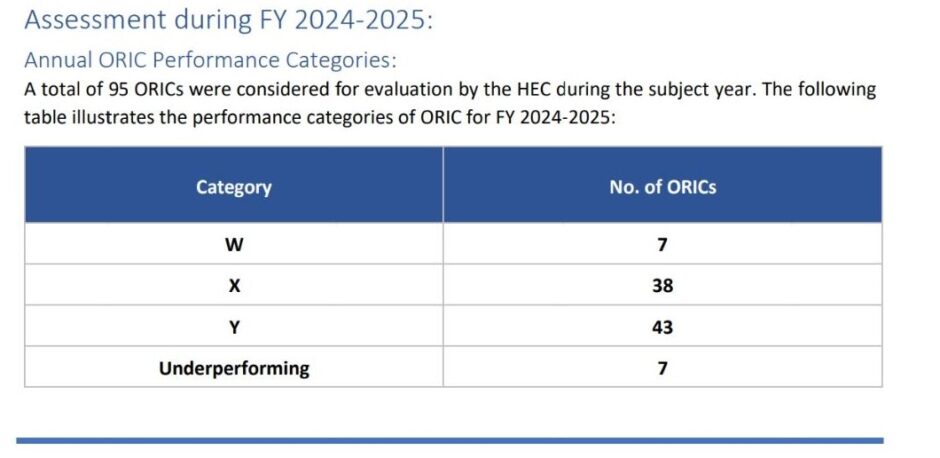
The W category requires a score of 80 or above. Seven universities cleared that bar: Air University Islamabad, NUST Islamabad, NED University of Engineering and Technology Karachi, Sukkur Institute of Business Administration, The University of Lahore, University of Agriculture Faisalabad, and Ziauddin University Karachi. These institutions will receive 15% overhead funding on all HEC-sponsored research grants, a direct financial reward tied to the ranking.
The X category, covering scores of 60 to 79, captured 38 universities and carries a 10% research overhead. The Y category, covering scores of 40 to 59, held 43 universities at a 5% overhead rate. Universities that scored below 40 and landed in the Underperforming category receive zero overhead funding on research grants. From the uploaded report, the underperforming institutions include Shah Abdul Latif University Khairpur, Shaheed Zulfikar Ali Bhutto Medical College Islamabad, Bacha Khan University Charsadda, University of Swat, and Shaheed Benazir University for Women Peshawar.
The report assessed universities across four KPI domains: Human Resource and Operations (10 points), Research Excellence (45 points), Innovation and Commercialization (30 points), and Sustainability and Capacity Building (15 points), totaling 100 points.
Meanwhile, research proposal volume surged dramatically. Universities submitted 9,987 proposals in FY2024-25, up from 2,237 the previous year. However, the approval rate collapsed from 41% to just 12%, reflecting intensifying competition and constrained funding availability.
HEC also flagged that only 68.42% of universities currently have full-time ORIC heads, identifying the leadership gap as a key drag on institutional research performance. Seventeen universities improved their category from the prior year while 4 declined.