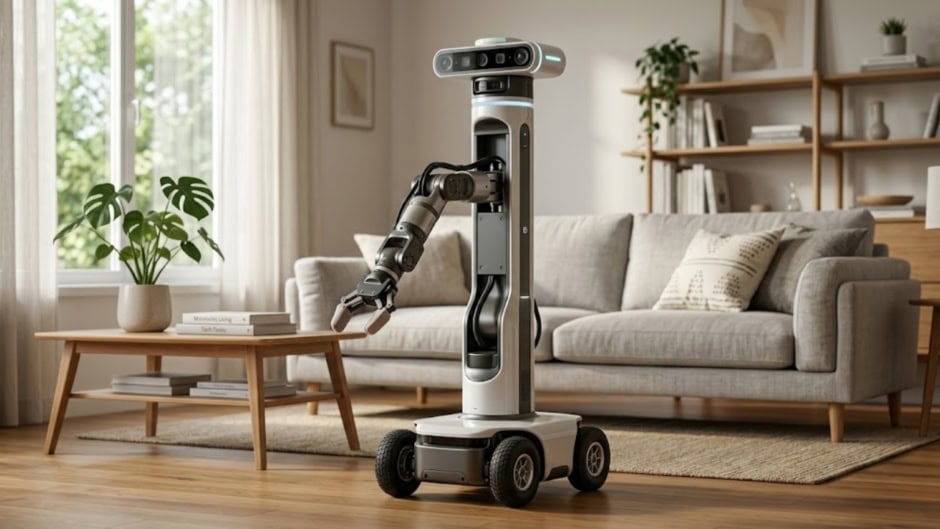
While Silicon Valley pours billions into flashy humanoid robots, a small startup in Martinez, California, is taking the opposite approach.
The company Hello Robot just released the fourth generation of its home assistance robot, Stretch, and it is already doing something most rivals are not: working in real homes, with real people.
Stretch barely qualifies as a humanoid robot. It has a vaguely human torso and a sensor-studded head, but its telescoping arm ends in a pair of pincers, and it rolls around on a heavy, omnidirectional wheeled base. When its batteries run low, lights around its eyes glow in a way one company engineer jokes makes it “look angry.”
Hello Robot was founded in 2017 by CEO Aaron Edsinger, a former director of robotics at Google, and CTO Charlie Kemp, a professor at the Georgia Institute of Technology. The company is not building a foundation model or promising to replace every human job. Instead, it designs Stretch to operate safely around people in actual living spaces, at a time when most advanced robots remain behind glass in laboratories.
The biggest upgrade in Stretch 4 is its omnidirectional base, which lets the robot move in any direction without turning first. That makes it far easier for novice users to control, though such bases are notoriously hard to build. Hello Robot pulled it off using new omnidirectional wheels originally developed for powered wheelchairs, plus six months of focused engineering.
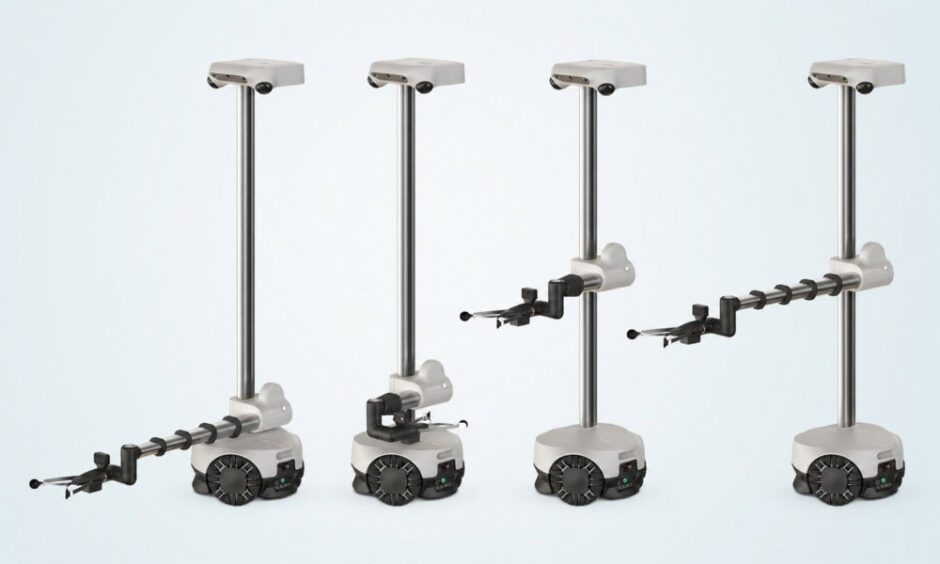
The robot also drops the previous model’s small pan-tilt head for a richer sensor suite with a much wider field of view. It carries a pair of hemispherical lidars, Luxonis cameras for vision and navigation, and a wrist-mounted depth camera for manipulation. Its main system runs on an Intel NUC 15, alongside an NVIDIA Jetson Orin NX that researchers can use for AI and visual processing. Edsinger says the team initially wanted cheap cameras like Tesla uses, but landed closer to Waymo’s philosophy: richer, more reliable data makes a safer, smarter robot.
Safety sits at the heart of Hello Robot’s pitch. Evans notes that emergency stops get used surprisingly often, and the difference between robot types is stark. A wheeled robot freezes in place when stopped. A bipedal robot collapses, potentially onto the patient beneath it. Kemp does not mince words: “The safety aspect of humanoids in a home freaks me out.”
Hardware remains the hard part across the industry. Despite huge investment in robot “brains,” robot bodies still struggle with heavy limbs, high-energy balancing, and unforgiving physics. When robots fail, they break things. One startup, the Bot Company, is now being sued by a San Francisco Airbnb owner who says its robot scratched furniture, broke appliances, and chipped bathroom tiles during secret testing.
Hello Robot does not claim Stretch will match the complexity of the humanoids that captivate the Valley. Instead, it wants to be the trusted platform that foundation model developers build on top of. IEEE Spectrum’s robotics editor predicts the next version, Stretch 5, could become the first genuinely practical, affordable assistive home robot, possibly within a year.
The race to put robots in homes is no longer about who builds the most impressive humanoid. It is about who builds something safe, affordable, and useful enough to earn a place beside real people. While the giants chase spectacle, Hello Robot is quietly logging the operating hours that may matter most. In a field where data is the real prize, the company willing to show up in living rooms first could end up shaping what every home robot becomes.