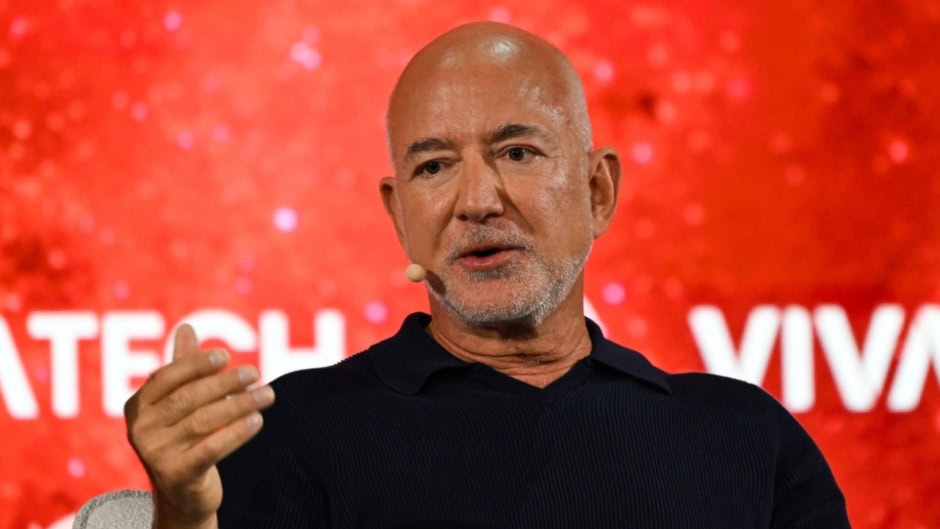
Jeff Bezos predicted that artificial intelligence will create more jobs for humans rather than replace them, pushing back against widespread concern about AI-driven unemployment during an appearance at VivaTech, Europe’s largest tech conference, in Paris.
“I know there’s a lot of concern that many people have, including many smart people, that AI is going to make humans redundant and so on,” Bezos said. “I totally disagree with this point of view. And I think, in fact, AI is going to create a labour shortage.”
Bezos argued that people are limited not by a lack of ambition but by barriers that technology can help remove, painting an optimistic picture of AI’s role in society. His comments stand in direct contrast to warnings from other tech and political figures, including former UK Prime Minister Rishi Sunak, now an adviser to Microsoft and Anthropic, who recently said AI was already affecting young people’s job prospects.
Bezos was speaking partly about his new AI venture, Prometheus, which focuses on accelerating physical manufacturing. He also outlined a long-term vision for space exploration, describing space as “supply constrained, not demand constrained.” He identified the Moon as humanity’s natural starting point for expansion beyond Earth due to its proximity and resources.
“We’re going to the Moon to stay, not just to visit,” he said, adding that technologies like electrolysis could eventually let lunar resources refuel rockets and support a permanent human presence.
Bezos also addressed a recent setback at Blue Origin, where an uncrewed New Glenn rocket exploded during a ground test at Cape Canaveral in May.
“It was a gut punch for the whole team. But what we’ve learned since then is we got really lucky,” he said, noting that critical launch infrastructure, including propellant and fuel systems, survived the incident.
Away from the main stage, the conference’s most popular attraction had nothing to do with rockets or job forecasts. Unitree’s humanoid robot drew constant queues of visitors throughout the event, this time demonstrating a partnership with French neuro-AI company HABS. The collaboration showcased technology allowing humans to control machines using cognitive signals rather than speech or touch.