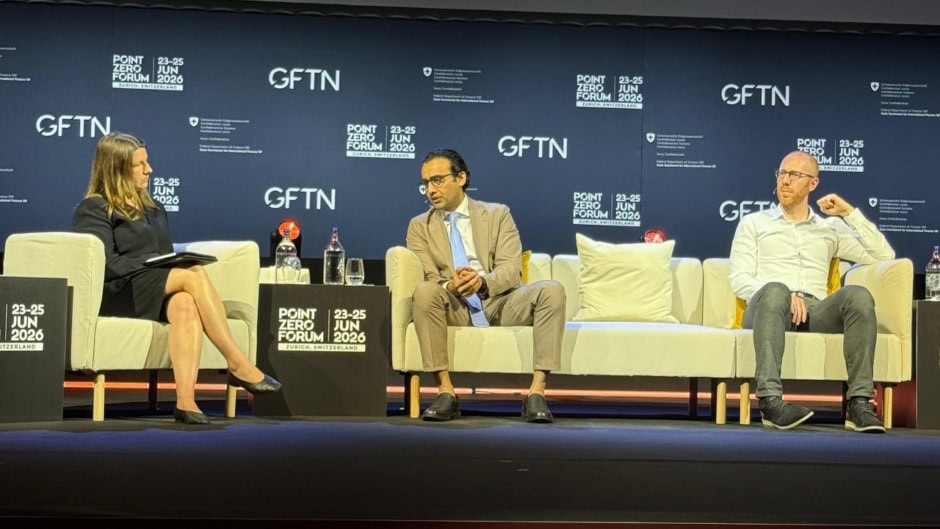
The rules governing global money are being rewritten, and Pakistan intends to help write them. This bold declaration came directly from Bilal Bin Saqib, Minister of State and Chairman of the Pakistan Virtual Assets Regulatory Authority (PVARA). He addressed global financial elite at the prestigious Point Zero Forum 2026 in Zurich. The high-profile event took place from June 23 to June 25 at the Kongresshaus Zürich. It brought together over 2,000 central bankers, regulators, and industry leaders.
Speaking on a major panel, Bin Saqib made it clear that Pakistan is no longer just a passive observer in the digital asset space. Instead, the country is stepping up as a key architect of the world’s new financial system.
A “Pakistan-First” Strategy for Digital Assets by PVARA
Bilal Bin Saqib spoke on a panel titled:
“Unchaining Tokenized Money: Stablecoins, CBDCs, and the Race for Scale”.
Central Banking Publications moderated the session. Dr. Mampho Modise, Deputy Governor of the South African Reserve Bank, also shared the stage.
The panel examined how to scale tokenized money, achieve interoperability across systems, and drive adoption. During the session, Bin Saqib delivered a direct message to a room full of traditional financial gatekeepers. Bilal Bin Saqib stated:
Money has become software, and software does not respect borders.
We are used to thinking of money as something a state simply has. A flag, a border, a currency. That era is ending.
He argued that for countries experiencing massive digital asset adoption, prohibition is no longer a viable choice. Therefore, the real choice is whether to govern the infrastructure or surrender it entirely to others. Consequently, Pakistan is pursuing a “Pakistan-first strategy” to ensure emerging economies shape the future of tokenized finance rather than inheriting foreign frameworks.
Why Global Leaders are Listening to Pakistan
Pakistan’s prominent presence at the forum reflects its explosive growth in the virtual asset sector. In fact, Pakistan now ranks third in the world for grassroots crypto adoption on the 2025 Chainalysis Global Crypto Adoption Index, trailing only India and the United States.
Several powerful factors drive this massive domestic adoption:
- A young, mobile-first population.
- One of the world’s largest freelancer economies.
- More than $38 billion in annual remittances.
- A public turning to stablecoins as a hedge against inflation.
As a result, Pakistani citizens adopted digital assets long before federal frameworks existed. Now, PVARA is actively building regulations to match the reality on the ground. PVARA is the federal authority responsible for licensing and supervising virtual-asset service providers in Pakistan.
Protecting Monetary Sovereignty at the Roundtables
Beyond the main panel stage, Bin Saqib participated in a series of senior, invitation-only roundtables. These private sessions placed Pakistan in direct conversation with central bankers and financial leaders from Singapore, Japan, the Philippines, the Gulf, and Europe. Top global banks and digital-asset institutions also attended.
The roundtables tackled a crucial question facing emerging economies today:
How can a country capture the high efficiency of dollar-denominated tokenized money without losing its monetary sovereignty?
Leaders discussed how to maintain control of national payment rails and retain visibility over internal financial flows.
The Point Zero Forum is co-organized by the Global Finance and Technology Network and Switzerland’s State Secretariat for International Finance. It operates in cooperation with the BIS Innovation Hub, the Monetary Authority of Singapore, the Swiss National Bank, and FINMA. This year’s theme was:
“A financial system rewired: trust, compliance and protocols in a shifting world”.
It highlighted the exact regulatory balance Pakistan is currently working to strike.
Ultimately, Pakistan is embracing the inevitable shift. As Bin Saqib concluded, the countries that succeed will be those willing to admit that the future is already happening. Thus, PVARA’s current mission is not to forbid that future, but to govern it well.