Meta has tightened its rules around what qualifies as original content on Facebook and Instagram, while also expanding the tools creators can use to detect stolen content and impersonation accounts.
The updated content guidelines spell out more clearly how much editing or transformation is needed for a repost to be considered original. Reels that incorporate third-party content, such as remixes or overlays, will only be classified as original when the creator adds something genuinely new, whether that is fresh information, analysis, or a substantial addition to the storyline. Simply watching along, reacting with facial expressions, stitching clips together, or narrating what is already on screen without adding meaningful value will be classified as unoriginal and deprioritized in Feed and Reels recommendations.
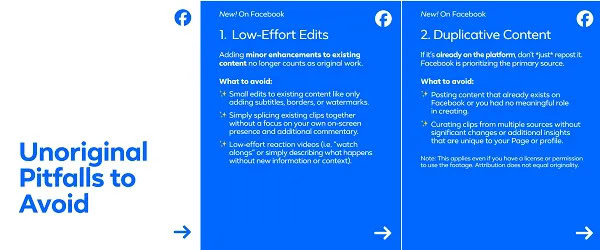
The change targets a format that has become a staple of content strategy for many influencers: low-effort reaction videos used to maintain posting frequency without the effort of producing something new. Without that option, creators may face a harder time keeping up the upload cadence that algorithms typically reward, which could lead to fewer videos being posted overall or push creators toward more burnout.
Meta explains that Reels that thoughtfully include third-party content, like remixes or overlays, are deemed original as long as the creator is showcasing something truly new, such as fresh insights, analysis, or significant enhancements to a story.
They clarify:
Simply watching along, reacting with facial expressions, stitching together multiple clips, or narrating what’s already visible on screen—without contributing anything meaningful—will be seen as unoriginal and will be given less priority in Feed and Reels.
On the protection side, Meta is expanding its content protection tools, first introduced last November, which alert creators when someone shares a Reel that closely resembles their original upload. The updated system now also flags possible impersonation accounts, which creators can review and report directly from their Professional Dashboard.
The changes are part of a longer-running effort. Last July, Facebook announced it would penalise unoriginal content, and in 2024, Instagram removed aggregator accounts from its recommendation system and began replacing reposts with original content where possible.
Meta says the push is producing measurable results. In the second half of 2025, both views and time spent watching original Reels on Facebook approximately doubled compared to the same period in 2024. The company also removed more than 20 million accounts impersonating large content creators over the past year.
For the creator economy, the message is clear: Meta is increasingly willing to suppress content that relies on other people’s work and reward creators who produce something genuinely their own. Whether the platform can enforce that distinction consistently at scale remains the open question.