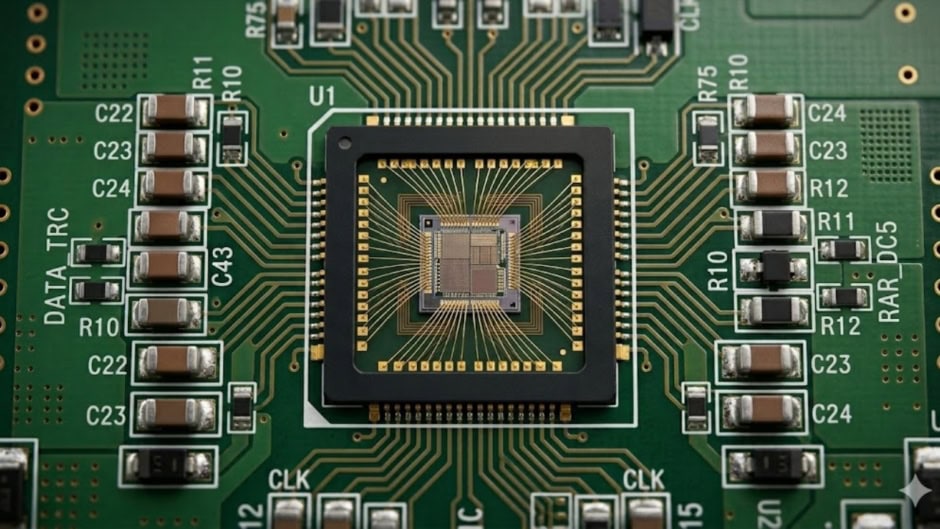
Scientists in Germany developed a new silicon-germanium chip that achieves the world’s highest combined sampling rate and bandwidth in a track-and-hold circuit. The advance could improve how data handles in communication systems, artificial intelligence and cloud infrastructure. The work comes from the Heinz Nixdorf Institute at Paderborn University as part of the PACE project.
Researchers say the new chip achieves the highest combination of sampling rate and bandwidth ever demonstrated in a track-and-hold circuit. This component plays a core role in converting analog signals into digital data. The chip captures extremely fast-changing signals and converts them into digital form for processing. This function remains critical in modern electronics where systems need to handle massive amounts of data in real time.
The team reports that the system can process more than 500 gigabits per second in a single channel using quadrature amplitude modulation. Gbps stands for gigabits per second and measures how much data can be transferred in one second, with one gigabit equal to one billion bits of information. To put this in perspective, 500 Gbps could transfer approximately 62 gigabytes of data every second, which means the entire Netflix catalog could theoretically be downloaded in just a few minutes at this speed.
In multi-channel setups, the data rate could exceed 100 terabits per second. This level remains relevant for long-distance communication networks. The new design uses silicon-germanium technology which allows faster switching speeds while reducing energy consumption.
Maxim Weizel, a research associate involved in the project, explained that transceibers act as ambassadors between analog and digital combining two functions of both sending digital data and receiving data from outside. Higher bandwidth allows more data transmitted in less time. This directly affects performance in servers, cloud systems and data centers. Network cards with higher bandwidth can significantly improve overall system efficiency.
The team faced challenges in measuring performance at such high frequencies. Even small errors can introduce phase noise or signal distortion making accurate testing difficult. Weizel stated they worked with extremely high frequencies which require extremely high precision, with even the smallest errors causing disruptive reflections or phase noise. The researchers relied on advanced simulations and high-performance computing resources to validate their design.
Weizel added that especially in the context of AI, high speed becomes a competitive advantage noting that large datasets and real-time communication demand faster processing. The development highlights the growing role of advanced semiconductor materials in pushing computing limits.
Silicon-germanium combines the manufacturability of silicon with improved electronic performance making it attractive for next-generation chips.