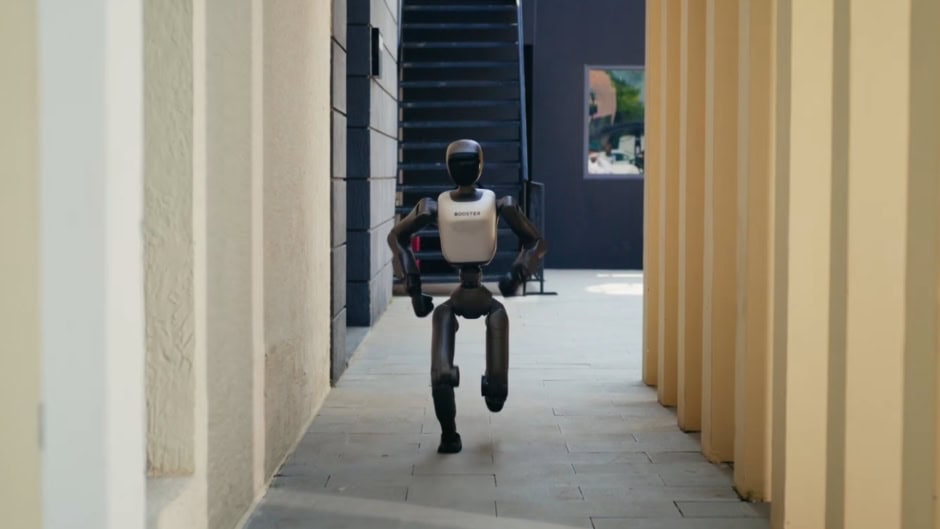
A Chinese robotics firm has unveiled a humanoid that thinks entirely for itself, though the brain inside is unmistakably American. Booster Robotics launched the T2 on July 13, powered by NVIDIA’s Thor chip delivering up to 2,070 TFLOPS onboard.
Booster T2 is an exciting new humanoid robot platform that’s all about advancing embodied AI research and tackling real-world robotics challenges. Built as an open development platform, this robot brings together bipedal locomotion, whole-body coordination, onboard AI computing, and modular hardware, making it a versatile tool for researchers looking to develop and deploy algorithms across various scenarios.
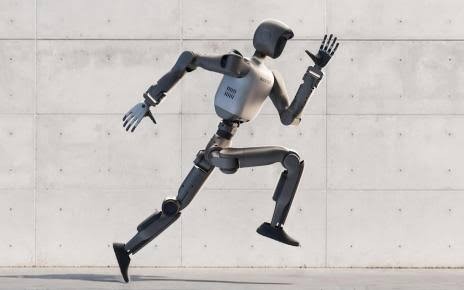
According to the company, Booster T2 is engineered to handle manipulation tasks while on the move, skillfully maintaining its balance through coordinated movements. It’s designed for applications that need mobility, perception, and object handling all in one package. In a demonstration video, you can see Booster T2 walking, bouncing back after falls, executing impressive flips, and displaying agile movement, balance, and AI-driven coordination in lively environments.

The company frames the goal plainly, since it wants humanoids to move from “being able to move” to “being able to work.” The compute is the headline, yet Booster insists the number itself misses the point.
As the company put it:
2070 TFLOPS is not the goal in itself, what matters is that this compute enables visual perception, multimodal understanding, task planning, and whole-body control to run in a real-time closed loop on-device. In short, the robot no longer executes isolated actions, since it perceives, judges, and acts continuously.
The body backing that brain is deliberately built for work. The T2 stands roughly 4.5 feet tall and weighs between 42 and 94.7 pounds depending on configuration. It carries 31 degrees of freedom, spread across six joints per leg, seven per arm, three in the waist, and two in the head, which is what allows coordinated whole-body movement rather than stiff, sequential motion.
The engineering choices signal industrial intent. Booster uses crossed-roller bearings and high-speed permanent-magnet synchronous motors, delivering a 10kg dual-arm payload and 140 Nm of peak joint torque. Buyers pick from three configurations, offering an optional end effector, a standard gripper, or a 6-degree-of-freedom dexterous hand for finer manipulation.
Perception is equally layered. Binocular cameras sit in both the head and waist, while higher-end models add wrist-mounted cameras for close work. A microphone array, speaker system, and optional LiDAR round out the sensing, and the robot supports Wi-Fi 6 and Bluetooth 5.2 alongside USB, Ethernet, and locking USB Type-C ports.
However, all things aside, China is pouring billions into domestic chips like the DF1000 precisely to escape US export controls, yet its robotics champions still queue for NVIDIA. Booster is not alone either, because Galbot has integrated Jetson Thor into its G1 Premium robot too. So the chip-independence drive has a visible gap, since robots need proven silicon now rather than promising alternatives later.
Jensen Huang has called Jetson Thor “the ultimate supercomputer to drive the age of physical AI and general robotics,” and robotics is now the company’s biggest growth opportunity despite being just 1% of revenue. It seems like NVIDIA knows they are irreplicable in the robotics field, at least for now.
Booster’s deeper play is Studio, its open development platform. Whoever owns the developer ecosystem shapes the industry, which is precisely why NVIDIA built Isaac GR00T for the same reason.