The Pakistan Telecommunication Authority (PTA) issued a public advisory on July 30 urging families to take active responsibility for their children’s online safety. The regulator called on parents to enable parental controls and age-appropriate content filters on Instagram, TikTok, and Facebook.
PTA wants parents having regular conversations with children about cyberbullying, online harassment, and digital threats. It urged families to monitor social media activity for inappropriate content or unsafe interactions. Personal information sharing drew specific attention, with PTA warning against children disclosing their location, photographs, and sensitive details online. The advisory extended beyond children, recommending that families avoid storing financial and health-related data on shared devices or platforms.
Just eight days earlier, on July 22, PTA and Meta signed a formal Letter of Intent focused on promoting online safety, digital well-being, and protective measures for children and young users in Pakistan. That partnership promises capacity building, policy dialogue, awareness campaigns, and exchange of global best practices. Both organizations agreed to work on content safety practices and strengthen digital safety cooperation. The advisory reads as PTA’s first visible output from that partnership, though it places the entire burden on parents rather than platforms.
The gap between advisories and legislation is now a documented pattern. In January 2026, five senators submitted a Calling Attention Notice proposing restrictions for children under 18. The Minister for Parliamentary Affairs proposed forming a multi-stakeholder committee to examine the issue. No such committee has been constituted, and no formal policy recommendations or draft legislation have emerged.
On February 11, 2026, the Islamabad High Court issued notices to the federal government, PTA, and PEMRA, seeking a comprehensive report by March 3 on measures to regulate minors’ access to social media. The petition was filed by 12-year-old Akbar Khan Shinwari through his father and legal counsel. Justice Arbab Muhammad Tahir stressed that “the well-being and safety of children from online harm are of paramount importance” and noted that unregulated social media exposes minors to cyberbullying, mental health issues, privacy violations and harmful content.
Separately, the Lahore High Court took up a similar petition filed by an eighth-grade student named Aalia Saleem in January 2026, with Chief Justice Aalia Neelum directing relevant authorities to submit responses. Unfortunately, neither court action has produced enforceable policy.
The legislative vacuum becomes even more glaring against the global backdrop the more layers are peeled off. In June 2026, British Prime Minister Keir Starmer announced plans to ban children under 16 from social media, with legislation expected by Spring 2027. Days later, the United Arab Emirates became the first Arab nation to legislate a nationwide minimum age of 15 for social media use. Australia banned under-16s from social media in November 2025. France enacted restrictions for users under 15 in January 2026. Indonesia became the first Asian country to introduce digital restrictions for children under 16 in March 2026. By early 2026, approximately 40 countries had initiated steps to restrict or ban social media use for minors. Sadly, Pakistan is not among them.
A peer-reviewed study published in Humanities and Social Sciences Communications in March 2026 examined cyberbullying victimization among 384 adolescents in Lahore’s public and private schools, documenting the socio-demographic factors driving digital vulnerability among Pakistani youth. Over 55% of respondents reported experiencing cyberbullying, with 62% specifically reporting threats received through text messages or online platforms. The study found that cyberbullying victimization was significantly associated with school sector and religion, with Muslim adolescents and public school students reporting higher rates.
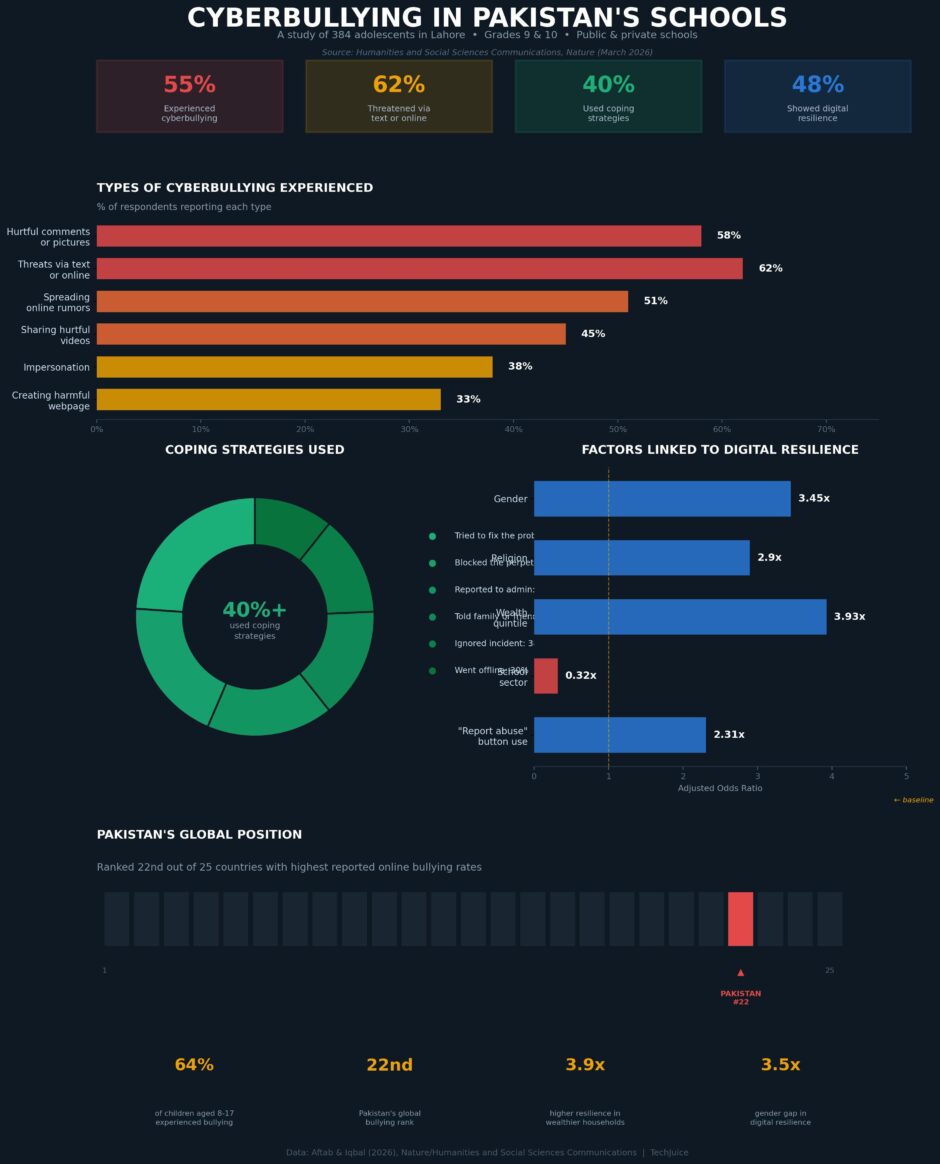
More than 40% of adolescents employed coping strategies such as blocking perpetrators or reporting abuse. Approximately 48% demonstrated what the researchers classified as strong digital resilience. However, the study also revealed that adolescents from lower wealth quintiles and those whose fathers had lower educational attainment were more likely to adopt maladaptive coping mechanisms.
PTA has enforcement tools, but for reasons unknown, it is not deploying them. The regulator has the authority to mandate age verification systems, require platforms to deploy stronger default protections for minors, or restrict access to non-compliant apps. PTA has blocked 5,175 websites hosting child sexual abuse material, demonstrating it can act decisively when it chooses to. Yet the regulator’s approach to mainstream platform regulation remains advisory rather than mandatory.
This becomes particularly contradictory given Pakistan’s web traffic reality. Adult content platforms occupy multiple positions in the country’s top 20 most visited websites, pulling over 43 million combined monthly visits with 94% mobile traffic. PTA has banned TikTok multiple times over content concerns yet allows explicit platforms to operate largely unchecked. Advising parents to monitor their children’s Instagram while adult websites rank higher than LinkedIn, Reddit, and X in national traffic exposes a regulatory contradiction the advisory itself does not address.
Pakistan ranks 22nd among 25 countries with the highest reported rates of online bullying, underscoring how far the problem has outpaced the regulatory response.