The Central Development Working Party (CDWP) has referred the Rs37.13 billion Pakistan Space Centre (PSC)project to the Executive Committee of the National Economic Council (ECNEC), marking a major step toward strengthening Pakistan’s indigenous satellite development capabilities.
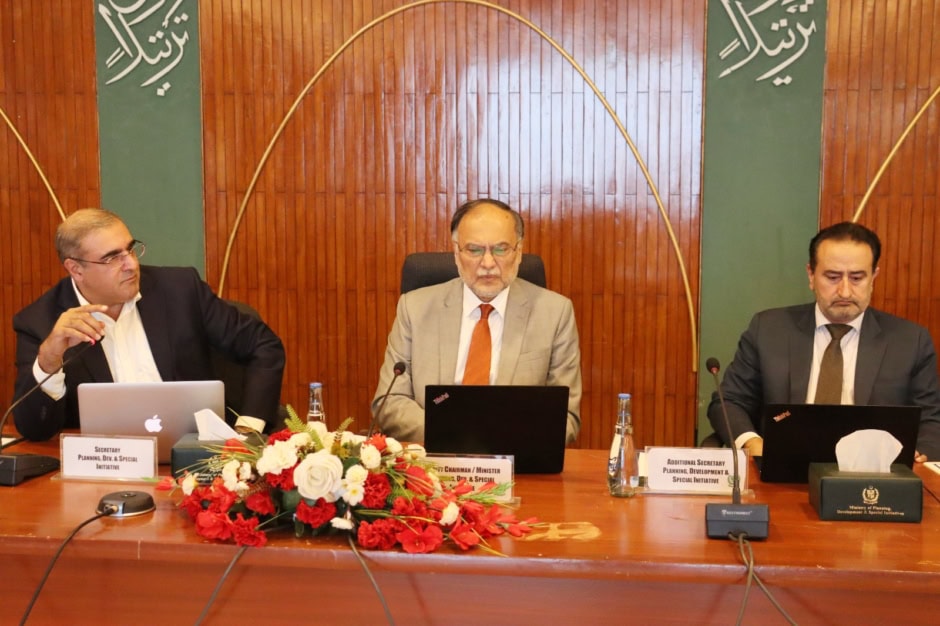
The decision was taken during a CDWP meeting chaired by Federal Minister for Planning, Development and Special Initiatives Ahsan Iqbal, where the forum approved seven development projects and reviewed several major national initiatives.
Overall, the CDWP approved four projects worth Rs12.437 billion and recommended three major projects worth Rs240.537 billion to ECNEC for final approval.
Pakistan Space Centre Sent to ECNEC
The revised “Establishment of Pakistan Space Centre (PSC)” project, sponsored by SUPARCO, carries an estimated cost of Rs37.13 billion.
According to the Planning Ministry, the centre will establish Pakistan’s indigenous capability to design, assemble, integrate, test, and qualify satellites, reducing reliance on foreign facilities.
Ahsan Iqbal described the project as a key component of the National Space Program (NSP)-2047, saying it would enhance Pakistan’s self-reliance in space technology while supporting the country’s strategic, scientific, and socio-economic objectives through cost-effective satellite development.
Four Higher Education Projects Approved
The CDWP also approved four Higher Education Commission (HEC) projects:
- Strengthening of the Women University of AJ&K Bagh (Rs2.55 billion) received in-principle approval, with a committee formed to rationalize project costs.
- Provision of Academic Facilities at Emerson University, Multan (Rs1.04 billion) was approved subject to cost rationalization.
- Establishment of Hyderabad Institute for Technology and Management Sciences (Rs4.56 billion) was approved, with directions to increase university buses from two to six through internal adjustments and remove the proposed endowment fund.
- Strengthening of KBCMA CVAS was approved after its revised cost was reduced from Rs5.49 billion to Rs4.28 billion.
During the meeting, Ahsan Iqbal directed the HEC to prepare a comprehensive university infrastructure master plan, ensure development work is awarded only to pre-qualified top-tier contractors, and appoint project directors strictly on merit and relevant professional experience.
Major Water Projects Also Referred to ECNEC
The forum also recommended two major water infrastructure projects to ECNEC:
- Lahore Water and Waste Water Management Project worth Rs31.59 billion, which includes a new surface water treatment plant, transmission pipelines, SCADA system, and a 5MW solar power system.
- Greater Karachi Bulk Water Supply Scheme (K-IV) Phase-I worth Rs171.81 billion, aimed at supplying 260 million gallons of water per day (MGD) through new intake structures, pumping stations, filtration plants, reservoirs, and transmission infrastructure.
While reviewing the Karachi water project, Ahsan Iqbal described it as a critical initiative to provide safe drinking water, improve public health, and reduce dependence on expensive private water tankers. He directed the Sindh government to submit a comprehensive implementation plan, including timelines for the project’s 50MW power supply and distribution network.
The projects are part of the government’s broader URAAN Pakistan development agenda, which focuses on infrastructure modernization, human capital development, improved governance, and sustainable economic growth.