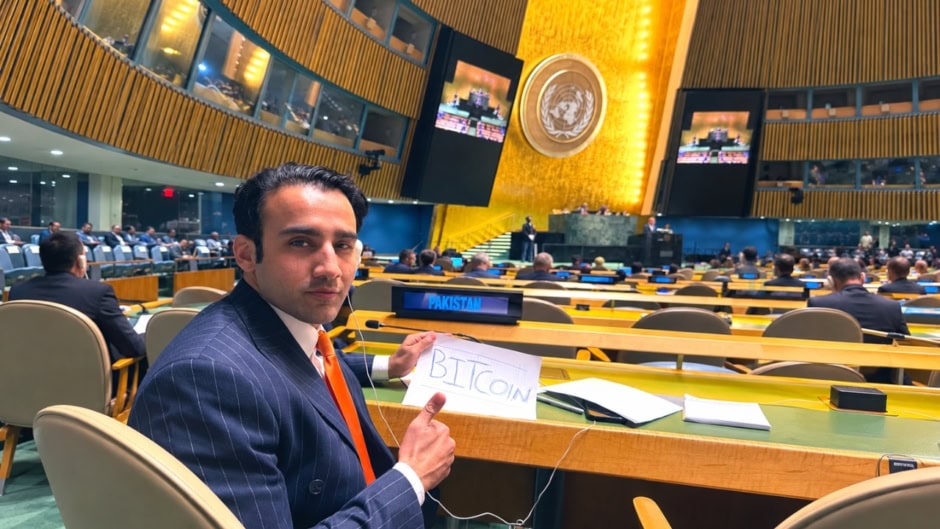
For the first time in UN history, a nation from the Global South hosted the opening policy dialogue on tokenization at the General Assembly. Pakistan didn’t just participate in the conversation about digital finance’s future. Pakistan orchestrated it.
The milestone carries weight that transcends ceremony. When Bilal Bin Saqib, Pakistan’s Minister of State and Chairman of the Pakistan Virtual Assets Regulatory Authority, stood at UNGA 81, he wasn’t defending cryptocurrency against skeptics. He was directing global conversation toward the structural realities that emerging economies face and the role tokenization must play in rebalancing global finance.
Finance Minister Muhammad Aurangzeb validated what few governments explicitly state:
“Pakistan is playing a crucial role in shaping the digital financial system’s future. Bilal Bin Saqib’s leadership in the virtual assets sector is essential to Pakistan’s strategic position.”
That’s not ceremonial praise. That’s ministerial recognition that cryptocurrency regulation has become a centerpiece of national economic strategy.
From Eight-Year Ban to Regulatory System in Six Months
Pakistan’s policy reversal illustrates why this moment is historic. For eight years, Pakistani financial institutions operated under a near-total ban on digital asset engagement. The prohibition was absolute. Banks could not custody cryptocurrency. Exchanges could not operate legally. The state had effectively ceded the entire ecosystem to informal, unregulated channels.
In 2024, that changed entirely. Pakistan moved from prohibition to a comprehensive regulatory framework in six months, faster than most nations accomplish fundamental shifts in any policy domain.
Bilal Bin Saqib articulated the reasoning with characteristic clarity:
“Bans don’t stop technology. They only remove the state from the field.”
When governments ban emerging tech rather than govern it, they surrender oversight, tax revenue, and policy influence simultaneously. The technology continues. The state simply loses a seat at the table.
The Virtual Assets Act established licensing pathways for exchanges, custody providers, brokerages, and related service providers. Regulatory sandboxes permitted pilot deployments. Consumer protection frameworks took shape. Market-conduct requirements emerged. What was once arbitrary restriction became coherent governance.
The result speaks for itself: Pakistan now hosts one of the world’s most vibrant digital asset ecosystems, with 40 million users representing among the largest and youngest user bases globally.
The Government Pace
At UNGA, Saqib delivered a line that captures why Pakistan now leads this conversation rather than follows it:
“Governments must move at technology’s pace, not committees’ pace.”
While other nations assembled working groups, Pakistan deployed regulation. While others debated frameworks, Pakistan piloted implementation. The speed of execution transformed Pakistan from laggard to pioneer.
More critically, Saqib addressed the core structural problem that makes this urgent for emerging economies:
“The global financial system is being rebuilt. The Global South must participate in making its rules, not merely accepting them.”
This is where the stakes clarify. Tokenization, stablecoins, and blockchain-based settlement are scaling whether or not emerging markets actively participate in their design. If Pakistan, Nigeria, India, and Indonesia remain passive, the architecture will reflect the interests of wealthy nations that designed it first. If they actively participate, writing regulatory frameworks, hosting infrastructure, and shaping standards, the architecture can instead serve financial inclusion.
Remittances, Sukuk, and the Practical Case for Tokenization
Saqib moved beyond principle to mechanics. Tokenization can make remittances faster and cheaper, directly addressing a problem that costs Pakistani workers hundreds of millions annually in transfer fees.
Currently, a Pakistani worker in the Gulf pays six percent to send money home. That’s not a technological necessity. It’s an architectural choice that incumbent financial systems deliberately made. When stablecoin remittances replace traditional channels, that cost collapses to fractions of a percent. For a nation receiving $30 billion in annual remittances, that difference equals billions in retained value.
More ambitiously, Pakistan is exploring tokenization of loans and sukuk, a move that would allow illiquid financial assets to trade on blockchain networks with near-instant settlement. This opens pathways for smaller enterprises and individuals to access capital markets previously available only to large institutions.
As Saqib framed it:
“Developing countries face large problems, but large populations can bring new opportunities in digital finance.”
Pakistan’s population advantage, 230 million people with a median age of 22, becomes an asset precisely when digital infrastructure allows direct participation in global capital flows.
Why This Matters Beyond Pakistan
Pakistan hosting the first UN policy dialogue on tokenization signals something larger: the Global South no longer waits for permission. At UNGA 81, for the first time, an emerging economy addressed the international community not on terms set by wealthy nations, but on terms emerging economies themselves defined.
Bilal Bin Saqib presented tokenization and AI not as speculative technologies but as essential infrastructure for financial inclusion. He spoke in the language of 1.3 billion unbanked people and 900 million mobile phone users who lack formal financial access. He connected abstract policy to concrete reality: a freelancer in Karachi loses years of work history because platforms restrict account access. A worker in Dubai cannot access cross-border capital. A farmer cannot tokenize agricultural yields for microfinance.
The Finance Minister’s public endorsement signals that this is not a rogue technology evangelist operating at the margins. This is the state’s official position, championed by ministerial-level figures, executed through formal regulatory architecture.
The Speed Test: What Six Months of Regulatory Execution Looks Like
The urgency embedded in Saqib’s language and in Pakistan’s execution speed reflects a genuine understanding of compressed timelines. Nations that move first in emerging tech governance will set precedent. Regulatory frameworks designed now will shape infrastructure for decades. Standards established in 2026 will constrain or enable innovation for the next generation.
Pakistan’s transition from an eight-year ban to a working regulatory system in six months is proof of concept: governments can move at technology’s pace when they choose to prioritize execution over endless consultation.
Pakistan now hosts infrastructure companies, attracts global crypto talent, and participates in setting international standards. Other nations still debating remain outside that conversation.
The Structural Reality
Pakistan possesses advantages that most emerging markets lack when entering digital finance infrastructure. The nation already operates one of the world’s largest freelancer populations generating over $1.6 billion annually. This workforce already understands digital payments, cross-border transactions, and the frictions that tokenization solves.
Pakistan’s tech-savvy youth population, educated and smartphone-native, represents a ready user base for digital finance applications. The nation’s experience implementing mobile money platforms like Jazz Cash and Easypaisa demonstrates institutional capacity to scale financial infrastructure rapidly.
Most critically, Pakistan’s leadership combined regulatory competence with genuine conviction. Bilal Bin Saqib didn’t arrive in government as a crypto enthusiast learning policy. He entered with both technical knowledge and social enterprise experience from addressing Pakistan’s water crisis. That combination of authentic belief and execution capability distinguishes Pakistan’s approach from nations pursuing tokenization purely for competitive positioning.
What Other Nations Can Learn
Pakistan’s path offers a template for emerging economies seeking to participate in digital finance’s future rather than watch it unfold. The template requires three elements: regulatory speed, clear institutional architecture, and ministerial-level commitment.
Pakistan delivered all three. The Virtual Assets Act established clear rules within six months. The Pakistan Virtual Assets Regulatory Authority created dedicated institutional capacity rather than scattering responsibility across multiple agencies. Finance Minister Muhammad Aurangzeb’s public endorsement signaled that this is core economic strategy, not peripheral experimentation.
Pakistan now shapes conversations at the UN, hosts regulatory dialogues, and attracts the talent and capital that all emerging markets want. At UNGA 81, Pakistan didn’t ask for a seat at the table where digital finance’s future is designed. Pakistan claimed one and demonstrated it possesses the regulatory competence, strategic vision, and ministerial commitment to sit there meaningfully.