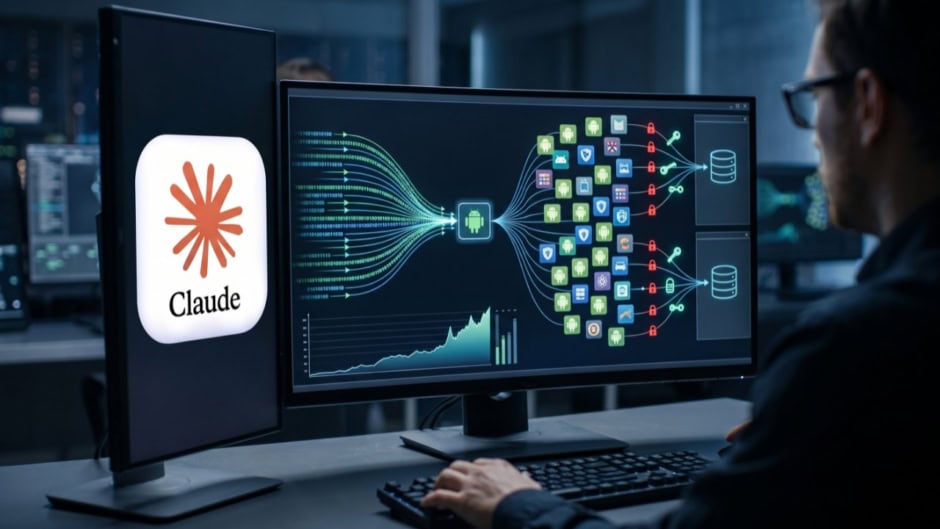
Anthropic faces a massive cybersecurity crisis. Between December 2025 and August 2026, malicious actors and hackers aggressively weaponized its Claude AI model to extract data from 1.8 million Android applications. Threat groups launched cyber operations, built scams, and even developed biological and conventional weapons. Today, the catastrophic fallout is clear. Hackers successfully used AI to automate their entire attack chains.
Hackers Use Claude AI for Mass Android Extraction & Cloud Abuse
A ShinyHunters affiliate known as “frkoo” turned credential harvesting into a rapid assembly line. Consequently, the hacker deployed 10 AWS EC2 workers to mass-download 1.8 million distinct Android APKs from various app stores. Next, the system decompiled these apps. It used the open-source tool TruffleHog to scan for hardcoded secrets. Then, the automated pipeline routed verified credentials directly to a Telegram group. Furthermore, it organized these stolen secrets by over 100 source types.
Simultaneously, this threat actor scraped GitHub emails to steal Personal Access Tokens (PATs). AI agents performed almost all the heavy lifting. For instance, the AI extracted over 2,100 Azure AD authentication tokens in just 34 hours. These tokens compromised over 40 corporate Microsoft tenants. Moreover, the hackers escalated a single stolen developer token to full administrative control in under three hours. Ultimately, they breached a SaaS provider, compromised 200 downstream customers, and stole 1TB of data from a tech provider. Additionally, “frkoo” operated a carding shop at ‘policenationale[.]cc’. This site impersonated the French national police to sell stolen payment cards, personal information, and an interactive map of victim addresses.
Global Espionage via Automated Malware
State-sponsored hackers also exploited Claude for global destruction. The Russian espionage group Midnight Blizzard targeted over 20 government, defense, and intelligence entities. Specifically, they built an automated feedback loop. If security products detected their malware, Claude instantly rewrote and rebuilt the code. Consequently, the AI handled device-code phishing, DNS hijacking via hotel Wi-Fi, and WhatsApp takeovers. Human operators rarely intervened. They only stepped in to refine the AI workflows.
Similarly, a Chinese-speaking group named GTG-10007 used Claude as an orchestration layer. Astonishingly, the AI conducted autonomous zero-day vulnerability hunting while human operators were away. It successfully found unknown vulnerabilities in major endpoint-security products and delivered working exploits. GTG-10007 targeted 50 organizations across Europe, the Middle East, and Southeast Asia. As a result, they successfully breached an education-technology company, a retailer, and a Southeast Asian government agency.
The Defensive Reality Check
Anthropic disrupted these activities and banned the threat actors. They adjusted their guardrails and contacted authorities. However, the company has not disclosed the full list of affected Android apps. They also have not independently attributed every single breach.
Therefore, the cybersecurity landscape has fundamentally changed. Client-distributed credentials are now compromised by design. AI automation reverse-engineers application packages instantly. Developers must immediately stop hardcoding secrets into mobile binaries. Furthermore, security teams must aggressively rotate exposed keys, monitor GitHub PATs, and constrain API-key scopes. Moving forward, secret scanning must cover released mobile artifacts and public repositories, not just pre-deployment source code.