Everyone says Pakistan does not have a talent problem. Pakistan ranks as the world’s fourth-largest freelancing nation, generating over $400 million annually through individual contributors competing globally.
Its YouTube ecosystem crossed 1,200 channels with one million subscribers, and 60% of that watch time reaches international audiences.
Vyro AI built a globally competitive generative AI platform from Lahore. Sualeh Asif from Karachi co-founded Cursor, the AI coding tool now valued at $60 billion. The talent exists, proves itself on global stages repeatedly, and then boards a one-way flight out of the country.
So what exactly is the issue? Let’s explore the ground realities at the crossroads where Pakistan stands nearly 80 years after independence.
Where Pakistan Actually Stands Against the World
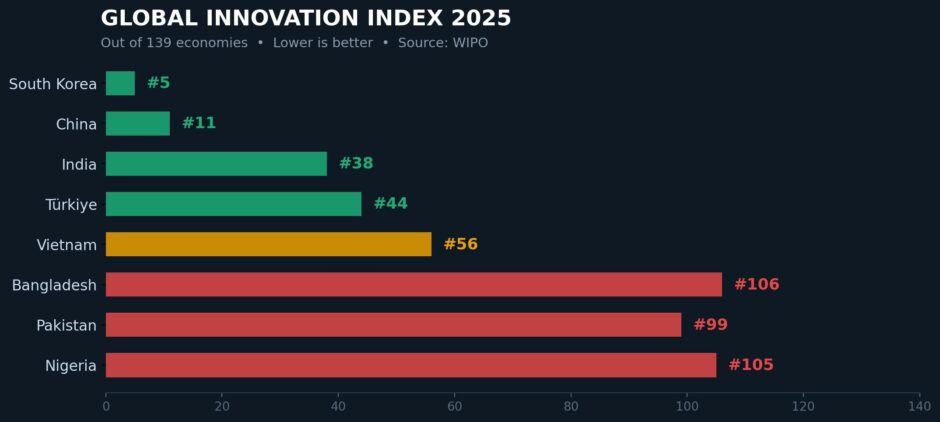
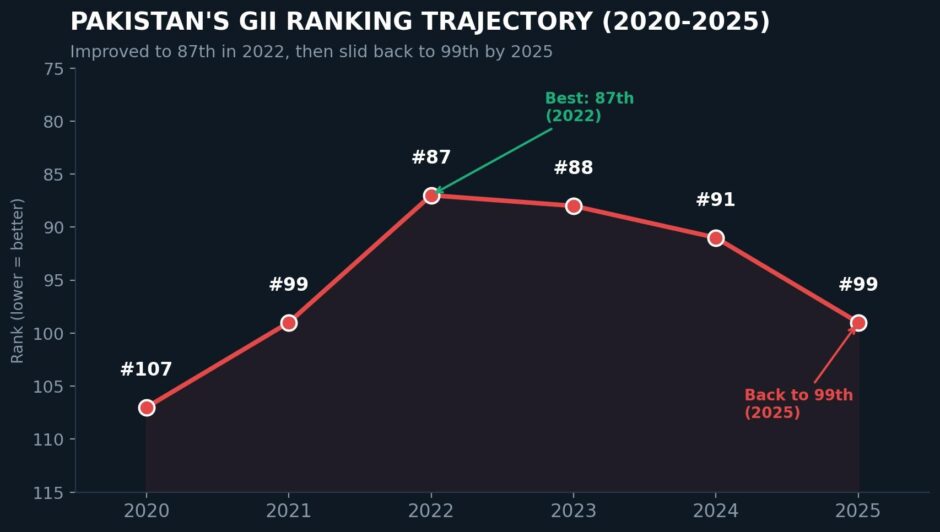
The Global Innovation Index tells the story in a single ranking that most Pakistanis have never seen reported alongside the talent statistics. Pakistan slipped from 87th in 2022 to 99th out of 139 economies in 2025, scoring 22.1 points against a global average of 31.49. India sits at 38th. Even Bangladesh, with a smaller economy and younger tech sector, has closed the gap and now ranks 106th. The GII sub-indices reveal where the collapse is concentrated: Pakistan ranks 124th in innovation inputs, 120th in infrastructure, and 117th in human capital and research. The country ranks 75th in innovation outputs, confirming that Pakistani talent produces disproportionately strong results from disproportionately weak inputs.
The R&D spending gap makes those rankings inevitable and nearly impossible to reverse without structural policy change. Pakistan spends 0.16% of GDP on research and development. India spends 0.65%. China spends 2.43%. South Korea spends 4.93%. Israel leads globally at over 5%. The world average sits at 2.7% for developed economies and 0.43% across all nations. Pakistan spends less than half the global average for all countries and roughly one-fifteenth of what China invests proportionally. That 0.16% translates into a research infrastructure so underfunded that the country has zero clusters in the GII’s global top innovation clusters, while India has four and China has 26.
The Funding Collapse
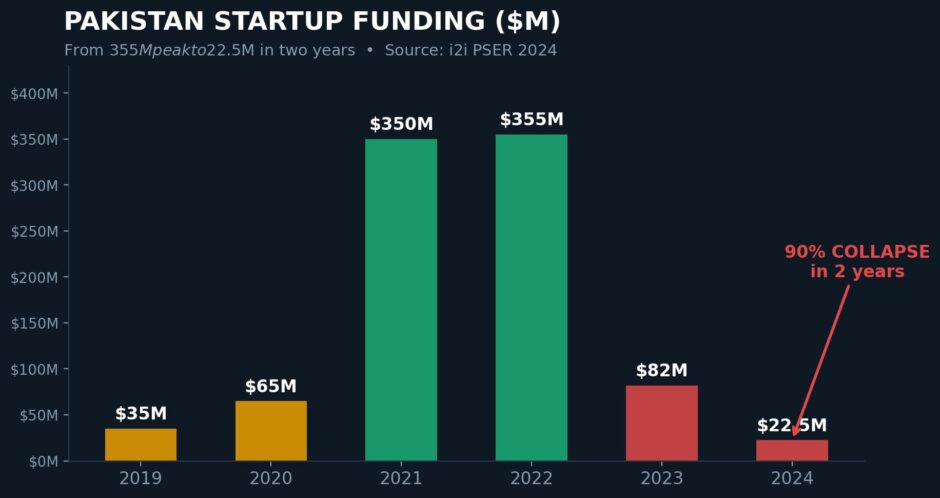
Startup funding crashed 90% in two years, falling from $355 million in 2022 to roughly $22.5 million in 2024. Pakistan has raised approximately $1 billion in total startup funding since 2015. The country hosts 170 VC-backed startups with a combined enterprise value of $4 billion, growing 3.6x since 2020 at a rate that outpaces India, New York, Paris, and Dubai.
Yet not a single Pakistani company has reached unicorn status or crossed $100 million in annual revenue. Limited domestic capital remains the primary bottleneck. About 32 startups raise first VC rounds each year, and the significant majority of growth funding arrives from abroad because domestic capital markets simply do not participate at the scale founders need.
China registered 55,000 new generative AI companies in the first half of 2026. Pakistan’s NAAI initiative targets 560 AI startups over two years. That is a 100:1 ratio with a country that decided to treat technology entrepreneurship as permanent national infrastructure rather than a government initiative that changes with every administration.
The Departure Numbers
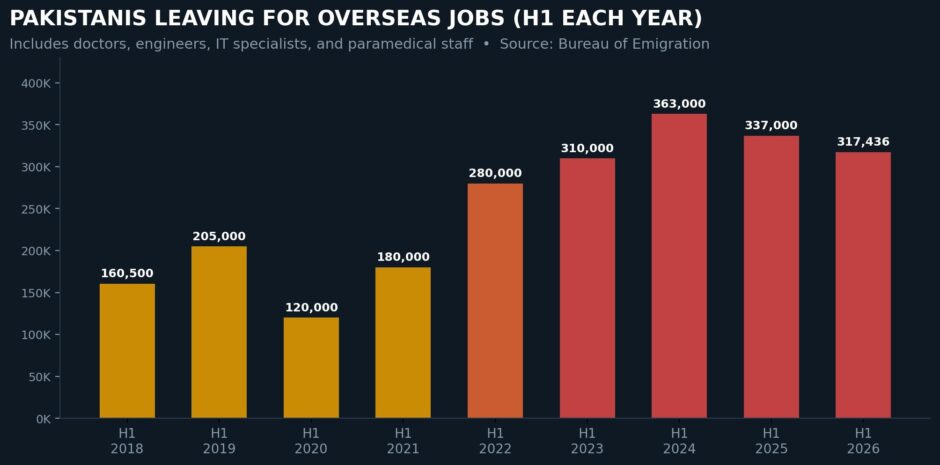
The Bureau of Emigration recorded 317,436 Pakistanis leaving for overseas jobs in the first six months of 2026 alone. Over two years, Pakistan lost 5,000 doctors, 11,000 engineers, and 13,000 accountants. The cumulative outflow is expected to exceed 1.5 million workers by year-end. Pakistan’s HDI ranking has declined from 161st in 2020 to 168th in 2025, one of the steepest falls globally. India, Bangladesh, and Sri Lanka all perform better, largely due to stronger investments in education, health, and governance.
What Actually Exists
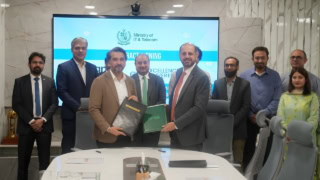
The government has taken steps that deserve acknowledgment alongside the criticism. SECP introduced a Regulatory Sandbox and the LEAP program. A five-year startup tax framework exists for registered companies. The Pakistan Startup Fund operates under Ignite, and has become strengthened with the recent Youth Policy initiated by the Ministry of IT. The FY 2026-27 budget allocated Rs. 19.5 billion to IT, up 20% year-on-year, and restored VC fund incentives. Pakistan deployed 1,136 5G sites across 23 cities in five months. Apple Music activated Pakistan-specific pricing, and Apple Pay integration appeared in iOS 27 beta code. These are real developments representing real progress.
But policy announcements do not automatically become ecosystem. South Korea spends 4.93% of GDP on R&D. Pakistan spends 0.16%. India ranks 38th in global innovation. Pakistan ranks 99th and falling. China builds 55,000 AI companies in six months. Pakistan plans 560 in two years. The distances are not closing. On several measures, they are widening.
Pakistan at 79 has the talent. It has fragments of infrastructure and emerging policy intent. What it lacks is the connective tissue that turns talented individuals into functioning companies, functioning companies into scaled enterprises, and scaled enterprises into the economic anchors that give the next generation of developers, doctors, and engineers a reason to stay rather than a reason to leave.
A dream for a Pakistan that is a technologically advanced and a leader in the region, we need to work more on the regions we are already excelling at, and pay special attention on areas where we conveniently turn a blind eye.