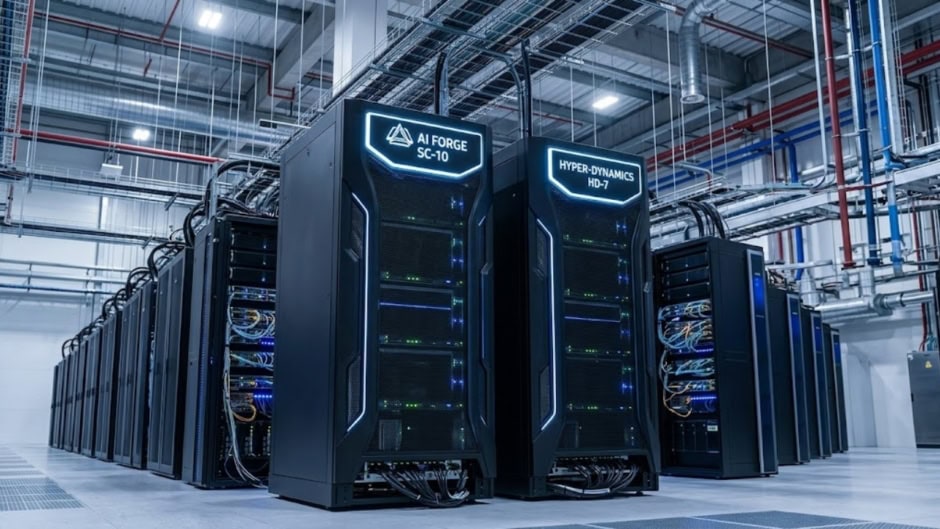
AMD and a group of major technology companies have launched the Optical Compute Interconnect Multi-Source Agreement consortium, an industry body aimed at defining open standards for how chips communicate inside AI data centres using optical connections rather than traditional copper wiring.
The founding members include Broadcom, Meta, Microsoft, NVIDIA, and OpenAI alongside AMD. The group’s goal is to establish shared specifications for optical interconnects that improve scalability, power efficiency, and performance across the massive computing clusters now required to train and run large AI models.
The move reflects a growing recognition that as AI workloads scale, the physical connections between processors, accelerators, and networking hardware are becoming a bottleneck. Copper links have bandwidth and distance limitations that optical connections can overcome, and a shared standard would allow cloud providers to mix and match GPUs, custom chips, and networking gear from multiple vendors rather than being locked into a single proprietary stack.
For AMD specifically, the initiative positions its Instinct GPU accelerators and EPYC server processors within a multi-vendor framework. Rather than competing on a closed ecosystem, AMD is betting that open interoperability will make it easier for large cloud customers to adopt its hardware alongside or in place of competing products. Co-authoring the standard with NVIDIA and major hyperscalers gives AMD earlier visibility into how customers plan to architect future AI clusters.
The risk, however, is that open standards can reduce differentiation. If optical interconnects become interchangeable commodities, all vendors, AMD included, could face pricing pressure. Implementing a new optical infrastructure at scale is also capital-intensive and technically complex, meaning adoption timelines remain uncertain.
The consortium aims to signal that the next competitive frontier in data centre design is shifting from raw chip performance toward system-level architecture, specifically how all those powerful processors are wired together.