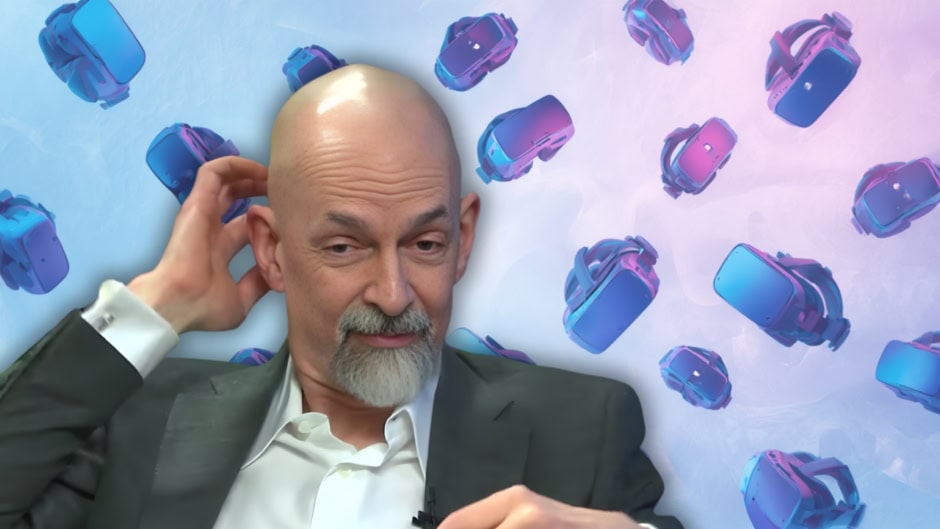
Neal Stephenson did not invent the VR headset. However, the word “metaverse,” which he coined in his 1992 cyberpunk novel Snow Crash, became the conceptual foundation for an entire industry.
In 2021, Facebook renamed itself Meta to chase that vision. By 2026, the company had reportedly spent $80 billion trying to build it. Last week, Meta shut down its metaverse project and laid off over 1,000 Reality Labs employees.
Now Stephenson has written a long essay declaring that the hardware vision he helped inspire, immersive virtual worlds experienced through goggles or glasses, was wrong.
“Maybe this should have been obvious to me given the amount of time, effort, and money people put into making their faces look as good as possible,” he wrote.
People do not want to wear things on their faces. More importantly, they do not trust those who do. Stephenson’s argument is not that virtual worlds failed. It is that the industry fixated on the wrong access device. When he wrote Snow Crash in 1990, computer graphics were experienced through heavy, blurry CRT monitors. It seemed entirely reasonable that the future would involve head-mounted displays rendering stereoscopic imagery. Instead, the combination of Moore’s Law, game engines, GPUs, and flat panel screens made it possible to bring 3D worlds to vivid life on cheap displays. The headset became unnecessary.
The numbers prove his point. Roblox has roughly 380 million monthly active users. Fortnite has 650 million registered players. Minecraft has around 60 million. All of them are virtual three-dimensional spaces where people run around in avatars and interact with strangers over the internet. The only thing that differentiates them from the metaverse, as Stephenson sees it, is that no goggles are involved.
The glasses problem, Stephenson argues, goes beyond comfort. Even slimming headsets down to resemble conventional eyeglasses creates a social problem that cannot be engineered away.
“When someone around you is staring at a rectangle in their hand, it might be incredibly annoying, but at least you can tell they’re doing it,” he wrote. “When someone’s wearing a head-mounted display, on the other hand, you don’t know whether they are looking at you or not. Likewise, when someone holds up their phone and aims it at you, it’s obvious that you are on camera. That’s not true in the case of glasses or goggles. So it’s creepy.”
The developer problem is equally fatal as the VR headset sales have been so low that no rational developer would invest years of work building for the platform without strong financial incentives. When hardware-dependent platforms close, all the software built for them ceases to exist.
“Devs who spent years of their careers crafting works of interactive art have seen it all wiped out,” Stephenson wrote. “With that kind of track record I consider it very unlikely that developers will sign on to build content for the next generation of headsets that comes along, supposing that ever happens.”
Stephenson also noted the timing problem. Generative AI arrived at exactly the wrong moment for the metaverse narrative. AI dramatically expanded cognitive capability across writing, speaking, and creating media, while the metaverse was trying to expand sensory immersion. For now, the cognitive upgrade captured nearly all of the public’s attention and investment.
His conclusion is that the metaverse his novel imagined already exists, distributed across multiplayer gaming platforms accessed through flat screens. The future, he suggested, lies not in hardware that straps to your face but in the successors to Fortnite and Roblox building more sophisticated shared worlds. As per Stephenson:
“Even one one-millionth of what Meta spent is enough to fund significant progress in this area if you have a small, talented, and dedicated team.”
After $80 billion and a company renamed in its honor, the man who started it all is saying the same thing the market already said: people are not going to wear things on their faces any time soon.