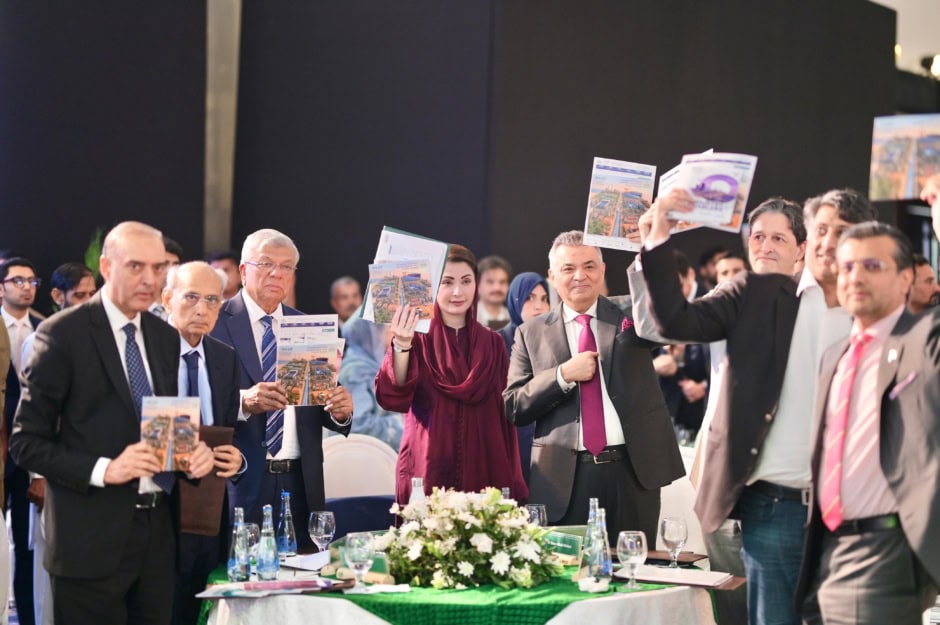
Punjab Chief Minister Maryam Nawaz Sharif has launched the Punjab Innovation, Value Addition and Economic Transformation (PIVOT) Plan 2026–29, a Rs1,995.3 billion economic strategy targeting $6.8 billion in additional exports, 162,000 direct jobs and improved livelihoods for more than one million people.
The three-year roadmap aims to position Punjab as an export-oriented industrial hub by strengthening manufacturing, promoting value addition, attracting private investment and expanding economic opportunities across agriculture, technology and tourism.
Speaking at the launch, Maryam Nawaz said Punjab was moving towards an economic growth model driven by industry, innovation, value addition and exports. She said the government aimed to create an environment where businesses could invest with confidence, industries could expand and people could access better employment opportunities.
Business Leaders, Bankers and Diplomats Attend PIVOT Launch
The launch brought together prominent business figures, policymakers, financial sector representatives, diplomats and international development partners.
Among the business leaders attending were Mian Mansha, Arif Habib, Fawad Mukhtar, Ziad Bashir and Osman Khalid Waheed. State Bank of Pakistan Governor Jameel Ahmad also attended, alongside senior executives from major commercial banks and financial institutions.
Representatives of the World Bank, Asian Development Bank (ADB), United Nations organisations and the diplomatic corps were also present.
Senior Minister Marriyum Aurangzeb, Chief Secretary Zahid Akhtar Zaman, provincial cabinet members, administrative secretaries and district-level officials attended the event.
Addressing investors and industrialists, Maryam Nawaz said the provincial government would facilitate businesses and encourage investment, adding that the private sector would lead economic expansion.
Rs300 Billion Concessional Financing Under STEP
A key component of PIVOT is the Strategic Trade Enhancement Programme (STEP), which envisages Rs300 billion in concessional financing for eligible businesses at interest rates ranging from zero to five per cent, subject to programme conditions.
The financing initiative will be supported by a digital portal designed to facilitate access to the programme.
The overall investment framework comprises Rs1,089 billion in public investment and a targeted Rs906 billion in private-sector investment.
Rs753.7 Billion Allocated for Industrial Development
The plan earmarks Rs753.7 billion for industrial development, manufacturing expansion, value addition and export competitiveness.
The government has allocated Rs50 billion for solar installations and Battery Energy Storage Systems (BESS) to help industries address energy costs. Another Rs50 billion has been earmarked for machinery duty reimbursements to encourage manufacturers to modernise factories and adopt advanced technologies.
Priority sectors include textiles and garments, sports goods, leather and footwear, surgical instruments, pharmaceuticals, fans, cutlery, steel and ceramics.
The programme also envisages modern testing laboratories, certification facilities and plug-and-play industrial infrastructure to help local manufacturers meet international standards and access export markets.
Four Agro-Processing Parks Planned
PIVOT also seeks to move Punjab’s agriculture sector beyond raw commodity production through investments in processing, storage and value-added products.
Four specialised agro-processing parks are planned in Sargodha, Khanewal, Okara and Bhakkar to reduce post-harvest losses and connect agricultural producers with higher-value supply chains.
The plan includes interventions for wheat, citrus, potatoes and mangoes, alongside export financing for horticulture and floriculture. Dedicated Horticulture Authorities are also envisaged in 20 districts.
Additional initiatives will target livestock, dairy, aquaculture, halal meat and milk value chains.
Skills Training for More Than 402,000 People
The three-year programme aims to train 402,060 individuals through demand-driven and industry-aligned skills development initiatives.
The training programmes will focus on workforce requirements across manufacturing, emerging commercial sectors and technology-oriented industries.
Tourism is another component of the plan, with proposed infrastructure improvements intended to develop destination economies and encourage private investment in hospitality and related services.
300 Government Services to Be Digitised
Under its business reform agenda, PIVOT aims to digitise 300 public administrative services through the E-Biz initiative, simplifying regulatory processes and improving access to government services.
The programme also targets the onboarding of 2,000 businesses onto e-commerce platforms.
Other proposed measures include labour law modernisation, public-private partnership reforms and schemes for leasing state land across nine productive economic sectors.
PIVOT Dashboard to Monitor Implementation
The provincial government has proposed a central governance structure to oversee implementation, with a PIVOT Board chaired by Senior Minister Marriyum Aurangzeb on behalf of the Chief Minister.
A dedicated PIVOT Secretariat will operate within the Planning and Development Department, while a separate PIVOT cell will be established in the Chief Secretary’s Office. Deputy Commissioners will serve as district-level focal persons.
Progress will be monitored through a central PIVOT Dashboard and an Industry Scorecard, using defined milestones and performance indicators to assess implementation and identify bottlenecks.
Chief Secretary Zahid Akhtar Zaman said the concept would be operationalised within six months.
Arif Habib Announces Pakistan’s Tallest Commercial Tower
The launch also highlighted private-sector investment interest, with businessman and real estate developer Arif Habib announcing plans to construct Pakistan’s tallest commercial tower at Lahore CBD One.
Senior Minister Marriyum Aurangzeb said the initiative was designed to position the government as a facilitator while enabling private businesses to drive economic growth.
The PIVOT Plan 2026–29 sets out a three-year roadmap for expanding Punjab’s industrial base, increasing exports, attracting investment and creating employment opportunities.
Its stated targets include $6.8 billion in incremental exports, 162,000 direct jobs and support for more than one million livelihoods, with implementation progress expected to be tracked through the proposed monitoring framework.