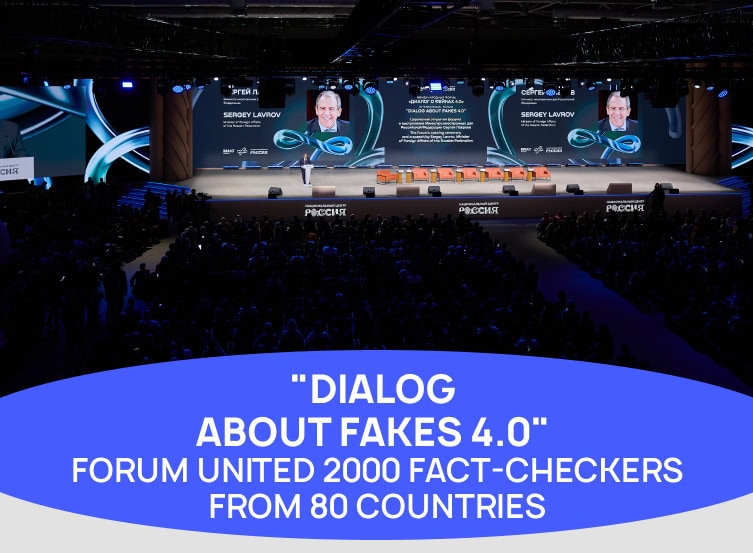
The “Dialog about Fakes 4.0” international forum brought together around 2,000 fact-checkers from 80 countries in Moscow on September 22 to discuss the growing challenge of false and misleading information.
Held at the National Centre Russia, the event brought together politicians, media professionals, industry experts, and fact-checking organizations to examine the impact of disinformation on politics, elections, financial markets, and businesses.
One of the major announcements at the forum came from Vladimir Tabak, President of the Global Fact-Checking Network (GFCN), who said the organization plans to establish its first international headquarters in Dubai, United Arab Emirates, under the name GFCN International.
Tabak said the move reflects the cross-border nature of disinformation and the lack of clear international regulatory frameworks for information-related conflicts.
“While Russia certainly serves as the foundational base for this initiative, we position it as an international endeavor,” Tabak said, adding that the Dubai hub would provide an additional platform for representatives of different countries, media organizations, and projects.
Russian Foreign Minister Sergey Lavrov also addressed the forum, highlighting its international participation. He noted that experts from the Global South, the East, and several Western countries were present at the event.
Delegates attended from countries including the United States, China, Brazil, Argentina, France, Spain, the Netherlands, Kazakhstan, Venezuela, Slovakia, South Korea, Pakistan, India, Iran, Iraq, Indonesia, Nigeria, Egypt, Belgium, Tanzania, Mexico, and Kyrgyzstan.
The 2026 forum focused on several issues, including the Russian State Duma elections, measures to protect election integrity from disinformation, and the wider impact of fake news on politics, financial markets, and businesses. Participants also discussed recent developments in artificial intelligence and its growing role in the arts.
Another session focused on online fraud targeting minors. Participants examined the increasing involvement of adolescents in cybercrime and digital delinquency. During the session, ANPO “Dialog Regions” presented research on financial scams targeting children and the growing use of AI-powered tools among young people.
The forum was organized by ANPO “Dialog Regions” with the participation of the Global Fact-Checking Network, which was co-founded by TASS Russian News Agency and the New Media School.